
Geology
Geology is the study of rocks. Our geology collection includes fossils (Palaeontology). The first specimens in our collection were donated by members of the Doncaster Microscopical and Scientific Society.
Amongst the earliest donors were Henry H. Corbett, the first Curator, Thomas H. Culpin and William Sawney Bisat. Donations included limestone related to the cutting of the railways and fossils found during the sinking of mine shafts. Several of their donations of fossils are probably type specimens of national and perhaps international importance. A type specimen is the one that was first used to define a new species.
In 1964, when the new museum opened on Chequer Road, specimens were donated from the National Geological Survey Collection, and from the Natural History Museum. They represent some of the most important fossil collecting sites in the country.
During the 1970s and 80s the collections expanded at a phenomenal rate, thanks to a volunteer with an interest in geology. A regional brick and ceramic building material collection was formed as a vital record of a once important Doncaster industry. A collection of minerals and precious gemstones was also developed. Highlights of the fossil collection include carboniferous fossils found in local coalmines and a complete ichthyosaur.
Crocodile skull and jaw 189-180 million years old. Jurassic Period from Whitby, Yorkshire
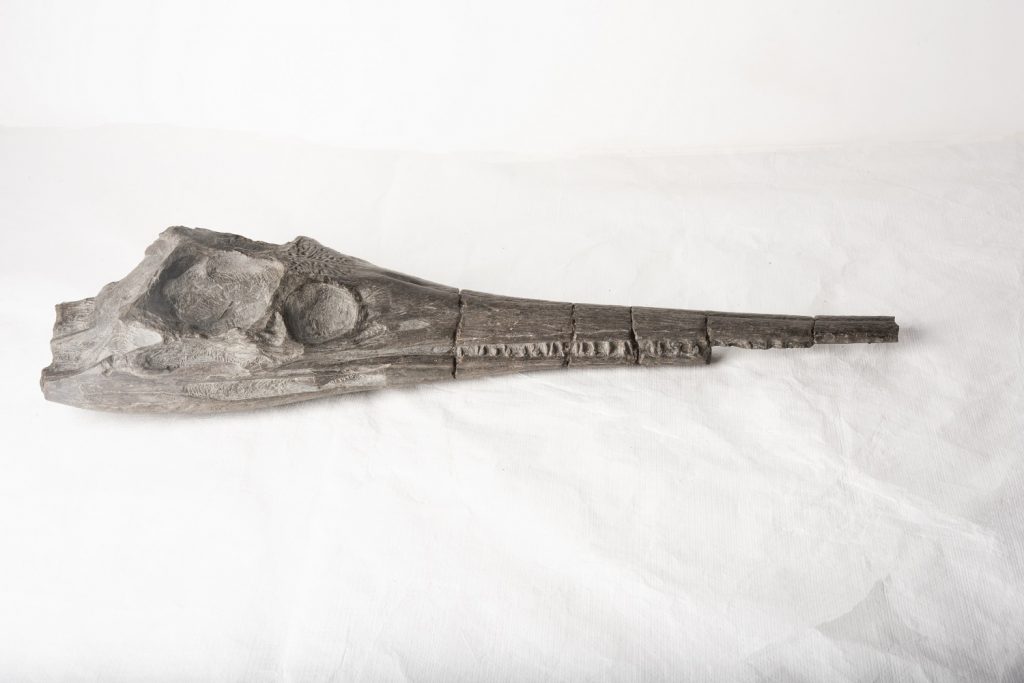
Steneosaurus (meaning ‘narrow lizard’) is an extinct type of crocodile. It had a long body, small forelimbs to help with swimming, and a long snout with thin, sharp teeth for eating fish. It probably lived in estuaries rather than the open ocean. It was similar in appearance to the long-snouted Gharial crocodile that still lives in India today. We know what Steneosaurus ate, because the remains of their meals have been found in fossilised coprolites (poo).
If you look closely at the fossil, you can see all the individual teeth in the jaws. On top of the head, between the two big eye sockets, you can see a strange patterned plate known as an osteoderm. These are a type of bony armour plating, which covered a large area of the crocodile’s body. These osteoderms are sometimes known as scutes, and are often found as individual fossils.
Fossil crocodiles are relatively common finds on the Yorkshire coast around Whitby and Scarborough. Here, in the Jurassic Period, there must have been a river delta running into the sea.
Tree Trunk 354-295 million years old. Carboniferous Period found at Hickleton Colliery
This large and incredibly heavy section of trunk is from a Carboniferous plant called Sigillaria. It was discovered in a coal seam deep underground by a local miner, and kindly donated to Doncaster Museum.
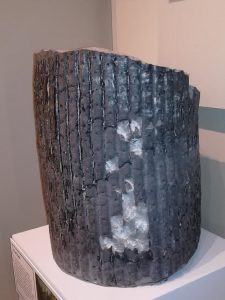
Sigillaria is an extinct type of tree-like plant, related to living clubmosses. Modern day clubmosses are low growing, and often live in mountainous regions. They can be found in the British Isles, but have a worldwide distribution. In Carboniferous swamp forests, the Sigillaria reached a height of around 30 metres.
Sigillaria had a long straight trunk, with a characteristic bark made up of vertically arranged tube-like segments. The canopy of the plant sprouted into grass-like leaves. The whole structure was stabilised by thick sturdy roots called stigmaria, which held the tall, heavy plant in place. Sigillaria grew rapidly, forming huge swampy forests. They had a relatively short life-cycle and when they died, the plants were covered in mud and compressed, and eventually formed coal.
Ichthyosaur 189-187 million years old. Jurassic Period from Lyme Regis, Dorset

Ichthyosaurs (meaning ‘fish lizard’) were marine reptiles that resembled dolphins and sharks. They thrived from the Triassic into the mid-Cretaceous Periods, and became extinct about 25 million years before the dinosaurs. An ichthyosaur’s average size was from two to four metres long. Ichthyosaurs would probably have had a wide range of prey, including belemnites, extinct animals related to squids. You may have noticed a dark area on this ichthyosaur. This is actually the gut contents! You are looking at the fossilised remains of the ichthyosaur’s last meal before it died. There are very small hook shapes, called hooklets, preserved in the stomach region. This shows that the ichthyosaur’s last meal was belemnites. The hooklets were attached to the belemnites’ tentacles, and hooklets are very rarely fossilised.
This ichthyosaur was discovered in the early 1970s along the coast of Lyme Regis. Doncaster Museum Service purchased it with the assistance of a Science Museum grant. The ichthyosaur was displayed briefly in the 1980s, but once the museum no longer had a Keeper of Geology, the fossil became temporarily detached from its information. It was not until 2009 that Dean Lomax, a local palaeontologist and currently visiting scientist at Manchester University, was able to rediscover it, and identify it as a new species. He named it ichthyosaurus anningae, in honour of Victorian palaeontologist Mary Anning.
Eurypterid 439-427 million years old. Silurian Period from Lesmahagow, Strathclyde
Eurypterids are often called sea scorpions, but they were more closely related to horseshoe crabs, which still have living relatives today. They lived in fresh water and fed on fish. Eurypterids were some of the most dominant predators of the time. They can grow to over 1.5 metres long.
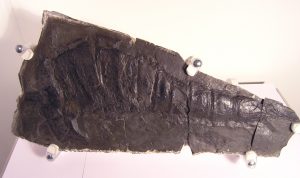
Eurypterid fossils are found in several places around the world, including Russia and North America. They are found in great quantity in the state of New York, so much so that the eurypterid is the state fossil.
The site where this specimen was found is now protected and excavation is rarely allowed. So this fossil is rare, and an important example.
Limestone block with remains of a fossilised tree branch from Hampole Quarry, Doncaster
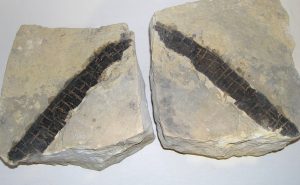
Two hundred and ninety million years ago, Doncaster was at the edge of a gigantic land-locked sea, known as the Zechstein Sea. The landscape would have looked very different then, a positively tropical delta, with rivers flowing into a sea teeming with reefs. But as the climate changed, getting hotter and hotter, the sea began to dry up, and the calcium-rich remains of creatures and minerals in the water formed what is now known as limestone.
This piece of fossilised wood is a remnant of the large tropical swamp forests that existed at the edge of the Zechstein Sea. It must have fallen into an estuary and been washed out to sea. It settled on the seabed and quickly became buried beneath sediments.
As early as 1849, the scientific community was studying limestone formation in this area. Eminent members of the Geological Survey met in Doncaster to examine and discuss the limestone, where it was visible in quarry faces and railway cuttings. James Haywood, a geologist of some repute, gave a lecture on the ‘Formation and Destruction of Limestone, and some of the Minerals which accompany it’.
Brick from No 1 Kiln from Balby Brickworks – Cocking & Sons

To the untrained eye this may just look like any ordinary brick. But it holds within its fabric the key to the shaping of the entire South Yorkshire landscape. In 1883, Thomas H. Easterfield, a Doncastrian and member of the Doncaster Microscopical & General Scientific Society, published a paper in the Proceedings of the Yorkshire Geological & Polytechnic Society. It was entitled ‘A Glacial Deposit near Doncaster’. The paper introduced the discovery of glacial boulder clays within the working faces of the Balby brick pits, and highlighted their geological significance. Easterfield, along with several other key members of the Doncaster society, including Henry H. Corbett (the first Doncaster Museum curator) and Thomas H. Culpin (a prolific museum donor, who helped shape the early collections), was able to produce significant insight from glacial erratics in the clay. This even settled discussions about how the landscape of South Yorkshire had been formed.
Balby Brickworks first opened in 1887, bought by the Wilson family, who continually fired unmarked bricks on the site until 1961. In the 1940s they sold part of the site to Cocking & Sons, who fired bricks in two kilns and marked the different types of their bricks ‘Balby 1-4’
Piece of anthracitic coal. Barnsley or Warren House Seam, Askern Colliery, Doncaster
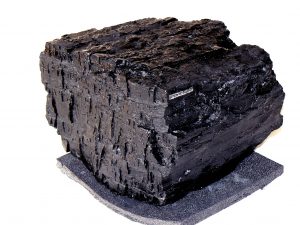
Almost anywhere you live around Doncaster, coal lies deep beneath your feet. It is often called the ‘Black Diamond’, and has shaped the landscape and fortunes of Doncaster and its people.
This piece of coal was the first piece to be mined at Askern colliery. In the 19th century, Askern was a spa retreat for the well-to-do. With the sinking of the first mineshaft on 5 December 1911, the village was destined to change forever. It quickly became a booming industrial centre. Coal was encountered only nine months after the first turf sod was removed, at a depth of 568 yards. On 20 September 1912, the Doncaster Gazette reported that the necessity of installing a pump, to drain serious build-ups of subterranean water, had led to the temporary drying up of the Spa Lake. It was also reported that the shifting of sub-soils had caused such severe subsidence, that the roofs and walls of some houses had cracked. They were so displaced they had to be propped up with scaffolding.