
The Betjeman Letter
The townscape of central Doncaster underwent significant and rapid change in the second half of the twentieth century. The 1960s were a time of particular change, when the first sections of a proposed orbital road around the town centre were completed. This project required a good deal of demolition – not least in the vicinity of the parish church of Doncaster St George. In 1962 Church Way was opened. This was an entirely new road linking North Bridge and Frenchgate to Wheatley Hall Road and its light industries. This development had been preceded by the removal of a sizable slice of the churchyard and the demolition of the former National School that had stood nearby. The plan to widen Church Way into a dual carriageway, had its origins in the County Borough of Doncaster Development Plan of 1954. This plan would ultimately result in the demolition of the Central Library, the Children’s Library (formerly Doncaster Grammar School) next door, and large parts of St George Gate and Frenchgate.
This state of affairs caused the then vicar of Doncaster, the Reverend Canon Michael James Jackson (1925-1995), a good deal of disquiet. The demolition of the nearby structures had potential to be a nuisance for a limited period. In the longer term, the presence of a dual carriageway skirting the churchyard and carrying traffic to and from the A1(M) Doncaster by-pass and the M18, heading around the town centre via the new Trafford Way, was a cause of a more long-term concern. Reverend Jackson was convinced that traffic on the existing Church Way was creating a level of vibration sufficient to threaten the fabric of the church.
He sought the opinion of the archbishop of York, who recommended that he consult the chairman of York Civic Trust, John Shannon, “loudly and clearly at the earliest possible moment. . . Don’t overlook the power of Press publicity”. He asked George G Pace, the diocesan consultant architect, to write a report on the likely effects of sustained use of Church Way by heavy traffic, and Pace duly obliged in April 1969.
Pace’s report found the vicar’s fears to be justified and Revd Jackson duly put the document to good use by sending copies to various persons of influence. From the vicar’s correspondence file on the subject, the recipients at this stage seem to have been: Richard Marsh (1928-2011), the minister of Transport; Michael Parsons, 6th earl of Rosse (1906-1979), who had a house not far from Doncaster at Womersley Park, and was a leading figure in the National Trust and a member of the ministry of Transport’s Trunk Roads Advisory Committee; H R Wormald, Town Clerk of Doncaster; and John Betjeman.
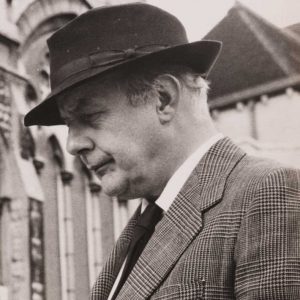
John Betjeman (1906–1984) was a much-loved poet, writer, and broadcaster. A founding member of The Victorian Society and a passionate defender of Victorian architecture, he had played a leading role in the campaign to prevent British Rail from carrying out its plan to demolish St Pancras railway station and the attached former Midland Grand Hotel. The campaign had been a success: St Pancras and its ex-hotel (then used for offices) received grade 1 listed status in November 1967 and the following year BR conceded defeat and abandoned its plans. When he wrote this letter he would already have known that the Queen’s Birthday Honours for 1969, to be published in less than a month, would announce that he was to receive a knighthood.
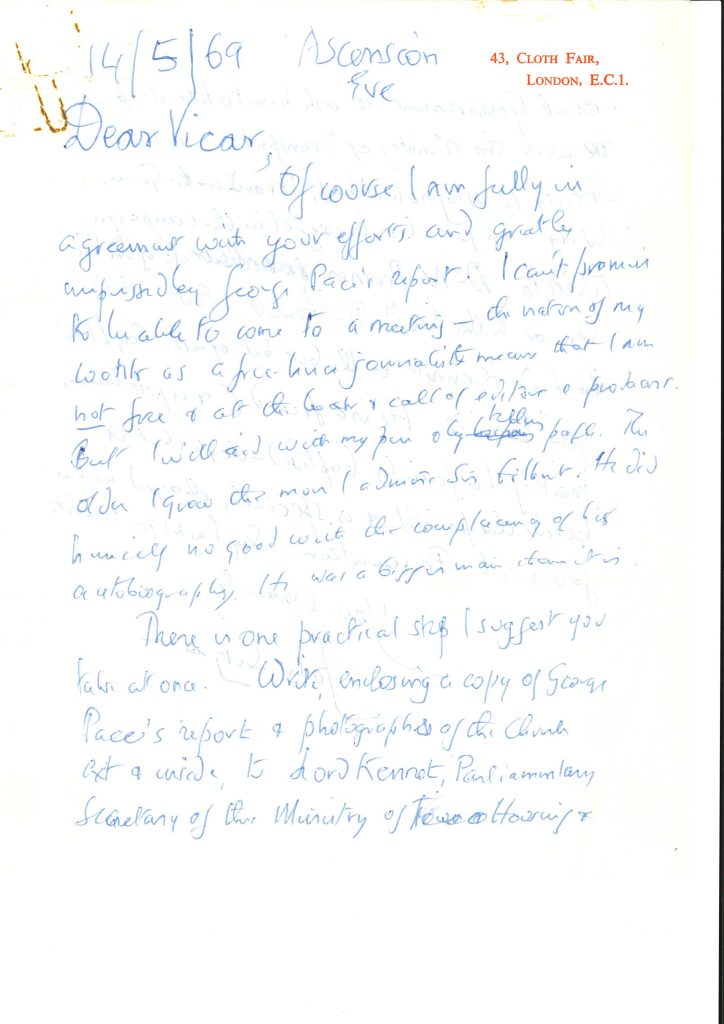
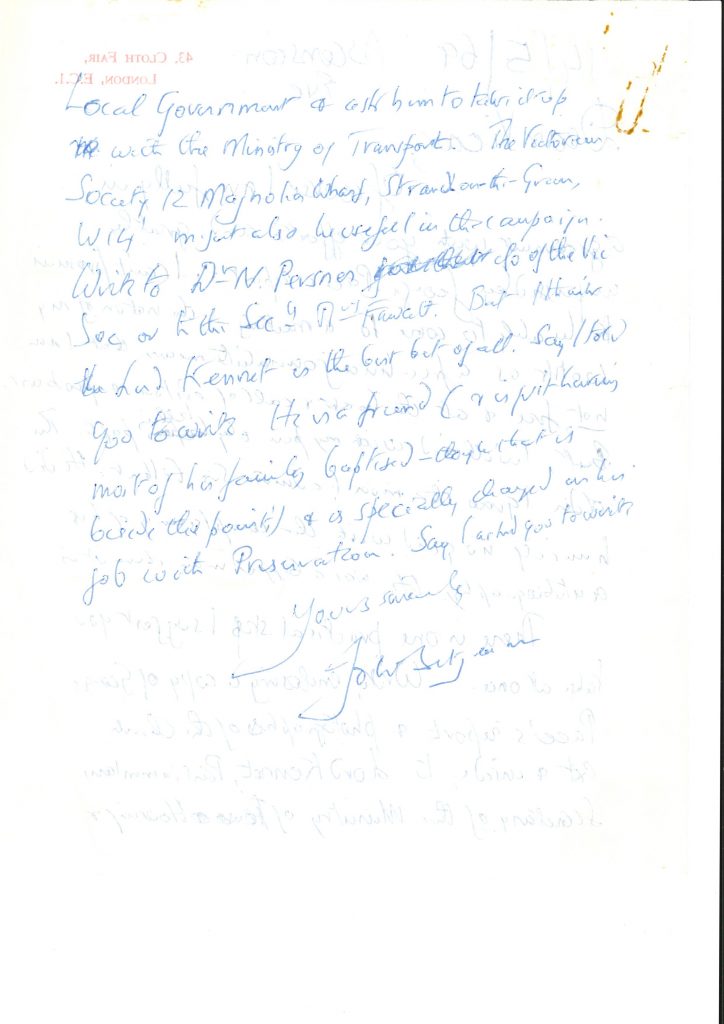
Revd Jackson knew that the Midland Grand Hotel, which was effectively the frontage of the station, had been the work of George Gilbert Scott – the same architect who had been commissioned to rebuild Doncaster St George after the medieval church burned down in 1853. This can only have made it seem likelier that the poet would prove a valuable ally in the vicar’s campaign. Whether Revd Jackson was disappointed by the letter he received from the future Sir John is unknown, but it is clear enough that Betjeman felt unable to spare the time to attend a meeting of an Association of Friends of Doncaster St George. He was very supportive, though: he was willing to aid with his pen and ‘by telling people’, and he supplied the names of three other persons that Revd Jackson might usefully contact.
Taking the view that the Victorian Society might be able to add its voice to the vicar’s campaign, Betjeman suggested two possible contacts. One of these was Dr Niklaus Pevsner (1902-1983), the German-born historian of art and architecture and founder member of the Victorian Society. Pevsner was and is best-known for his series of county-by-county guides to The Buildings of England, published by Penguin. He had commented favourably on St George’s in his West Riding of Yorkshire volume in 1959, but there is no indication that he was in communication with the vicar of Doncaster ten years later. The other was Mrs Fawcett, the secretary of the Society. Jane Fawcett (1921-2016), a former Bletchley Park codebreaker and, after her wartime service, an opera singer for fifteen years, became secretary – in effect chief executive – of the Victorian Society in 1964. For the next twelve years she ran the Society’s campaigns to save threatened buildings – often with conspicuous success. Even so, Revd Jackson’s correspondence file provides no evidence of contact with her or any other member of the Society.
The third name Betjeman put forward was that of Lord Kennet, parliamentary secretary to the ministry of Housing and Local Government. Wayland Young (1923-2009), 2nd baron Kennet, held the same junior ministerial post during the whole of the Labour administration of 1964-1970. Much of his work at the ministry had a particular focus upon planning and conservation. This, and the fact that he was a personal friend of Betjeman’s, inclined the poet to recommend him to Jackson as ‘the best bet of all’. Lord Kennet did indeed reply to Revd Jackson’s letter, but he clearly felt that the matter fell within the remit of the minister of Transport – by this time Fred Mulley – to whom he forwarded the letter and the accompanying copy of Pace’s report.
In the end, little came of Michael Jackson’s efforts. Part of the problem, as the town clerk pointed out, was that the decision about Church Way had already been made, with the then vicar and parochial church council giving their consent in writing in October 1960. The only option left to Revd Jackson was to oppose the compulsory purchase order that gave Doncaster Corporation the means to clear those buildings that stood in the way of the proposed second carriageway – and it didn’t matter whether or not the vicar could show that he had the support of prominent members of the conservation lobby, as no-one with the power to stop the road being widened was going to accept that the CPO itself threatened the fabric of his church.
There was, at least, the consolation that Doncaster Council had been persuaded to seek the advice of an independent expert, Professor W Eastwood of the department of Civil and Structural Engineering at Sheffield University, as to the likely effect on St George’s of vibration caused by an increased volume of traffic on Church Way. His report, which was circulated to interested parties in October 1969, recommended that materials and methods designed to limit vibration be used in the construction of the roadway. He also suggested that a monitoring scheme be established at the church using Demec gauges and a water levelling system. The Council accepted his recommendations and agreed to bear the cost of monitoring the church fabric for a five-year period.
By the time this period had expired, Revd Jackson had moved on to the parish of St Mary, Nottingham, and Sir John Betjeman had been appointed Poet Laureate – a position he held until his death. St George’s, since 2004 the Minster Church of Doncaster St George, has needed significant restoration work in the last two decades, although not, apparently, as a result of traffic-related vibration.
Doncaster Archives ref. P1/4/D11/5