
George Don: Soldier, Spy, Governor
Sir George Don was a soldier for over 60 years across the 1700s and 1800s, and his career saw him on campaign, governing territory across the British Empire, and perhaps even spying for the army and government across Europe.
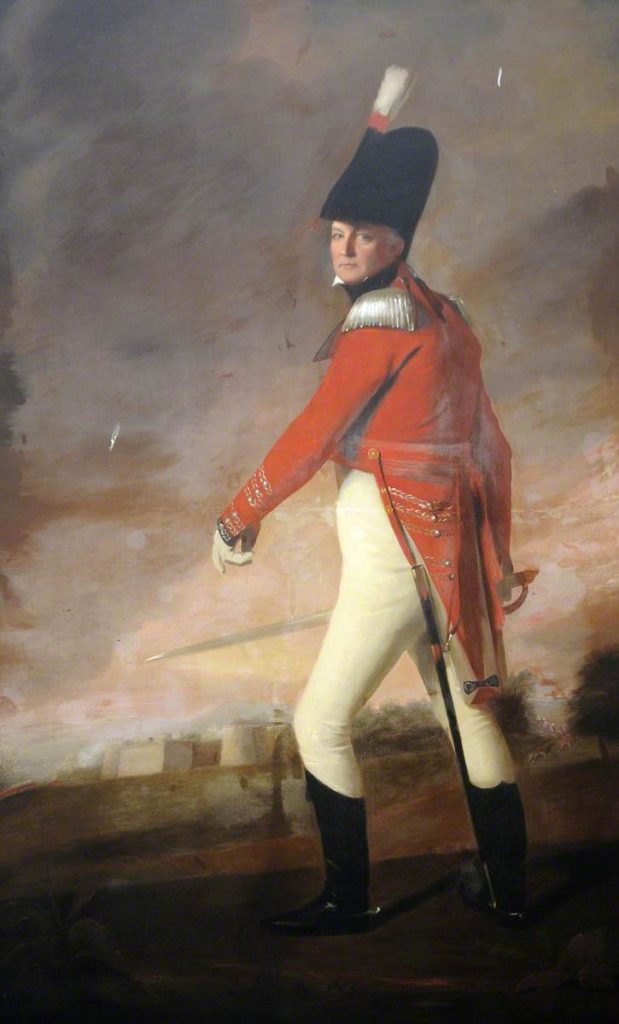
‘General Don’, a painting of George Don currently in Elizabeth Castle, St. Helier, Jersey (Art UK PW/0000/00030)
Though sir George would go on to have a long and distinguished military career, details about his early life are difficult to pin down. There’s some disagreement about when he was born, in either 1754 or 1756, to a wine merchant named John and his wife Anna, in Edinburgh. He joined the 51st Regiment of Foot, an ancestor of the King’s Own Yorkshire Light Infantry, as an ensign in 1770, aged about 15. Ensigns were the most junior of officers, and were often recruited quite young. They were responsible for carrying the regimental colours (their flag) into battle.
In 1774 George was promoted to lieutenant and in the same year the 51st were deployed to Menorca, one of the Balearic Islands off the coast of Spain. Menorca had been a British possession for most of the 1700s by that point, and was an important base for the Royal Navy in the Mediterranean at the time. While in Menorca George seems to have been introduced to General James Murray, governor of the island, and worked for a while as his aide-de-camp. This was a kind of military secretary or assistant, often called an ADC. ADCs are normally at least captains, and George was promoted accordingly in 1780.
From 1775 onwards Britain had been at war with the American colonies, who had declared their independence. As the war between Britain and the young United States continued, France and Spain eventually joined on the USA’s side, and they recaptured the island after a long siege in 1782. George made a name for himself during the siege however.
A year later George had gone from Captain to Major Don and had transferred briefly to the 71st and then the 59th Regiment of Foot, when he was transferred to duties in Gibraltar. By 1789 he’d risen to lieutenant-colonel, commanding his regiment. He’d remain in Gibraltar until 1791, when Europe was once again facing large-scale war, spurred by the French Revolution. As the young French Republic looked to its borders, and the monarchies of Europe worked to limit the new nation’s power and influence, a series of wars were fought throughout Europe that ultimately put Napoleon into power as emperor. George’s regiment was moved to Jersey in 1792, which was expected to come under French attack if or when Britain ended up at war with them. While his regiment prepared to defend Jersey, George was called away to serve as ADC to James Murray once again, who had orders to join a British army fighting in Flanders, Belgium. The campaign didn’t meet its objectives, but Don was promoted to colonel and given the title of ADC to King George III at the end. It’s worth noting that this was an entirely ceremonial post that still exists today, though it has been filled by other members of the royal family since the 1870s.
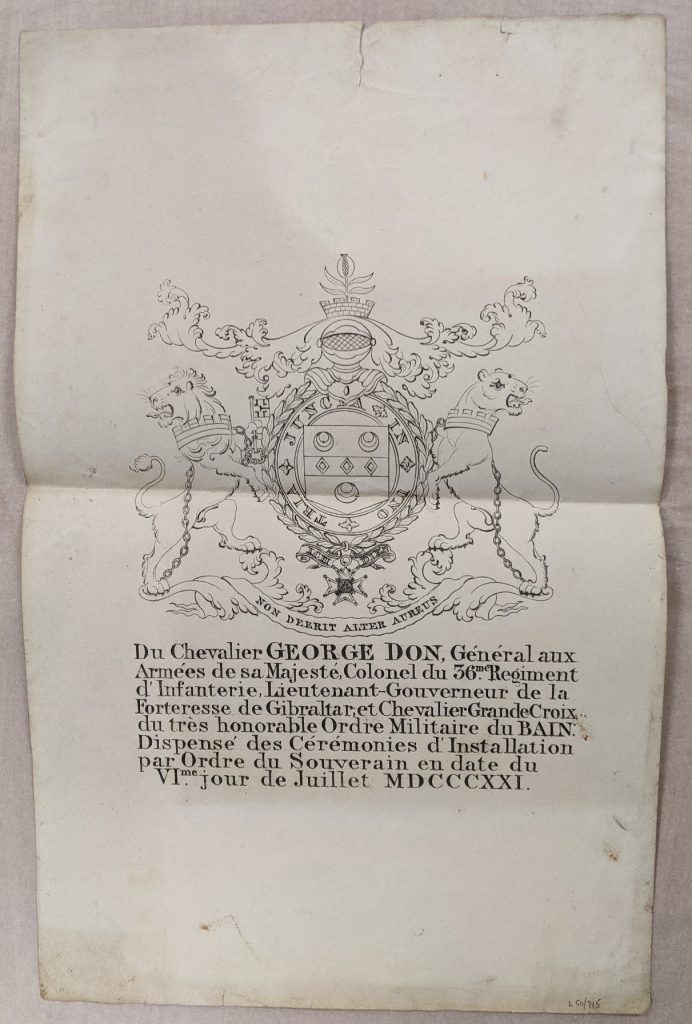
A copy of George’s coat of arms, reproduced for an installation ceremony in 1821, King’s Own Yorkshire Light Infantry Regimental Museum.
Colonel Don, as he was now, ended up in the service of the King of Prussia from 1795. We don’t know what he did while working for the king, but some people have suggested that he might have been involved in spying activities.
Possibly due to his experiences overseeing the defence of Jersey, in 1798 George was promoted to major-general and tasked with preparing defences for the Isle of Wight, thanks to concerns of a potential French invasion of Britain that never happened. After only a year he was sent to the Netherlands with another British army, where he carried out espionage work again. This time he was arrested by French authorities, under a flag of truce according to the KOYLI’s own records, and imprisoned for two years.
In 1800 George’s freedom was negotiated and he apparently returned home to Scotland, though we’ve not been able to confirm this in our own research. By 1803 he was in command of the King’s German Legion, a branch of the British army made up of German soldiers recruited from Hanover, during an expedition to recapture Hanover from the French.
1806 saw George once again return to Jersey, where he was made Lieutenant Governor. He’d hold this post until 1814, barring another trip to the Netherlands in 1809. He oversaw the defence and daily management of the island, including the training of its militia, the planning of defences in case of attack, and more. Finally in 1814, as the Napoleonic Wars were coming to an end, George Don was returned to Gibraltar. More than 30 years since he was last there, George returned not as a major in one of the garrison regiments, but as the acting governor of the territory. The official governor was absent, meaning that George carried out all the duties of the role. While there, he particularly ordered the construction of a new hospital and a public park called the Alameda. He also established a ’sanitary police’ to help counter a fever outbreak that evolved into the first professional police force in the empire outside of the British Isles.
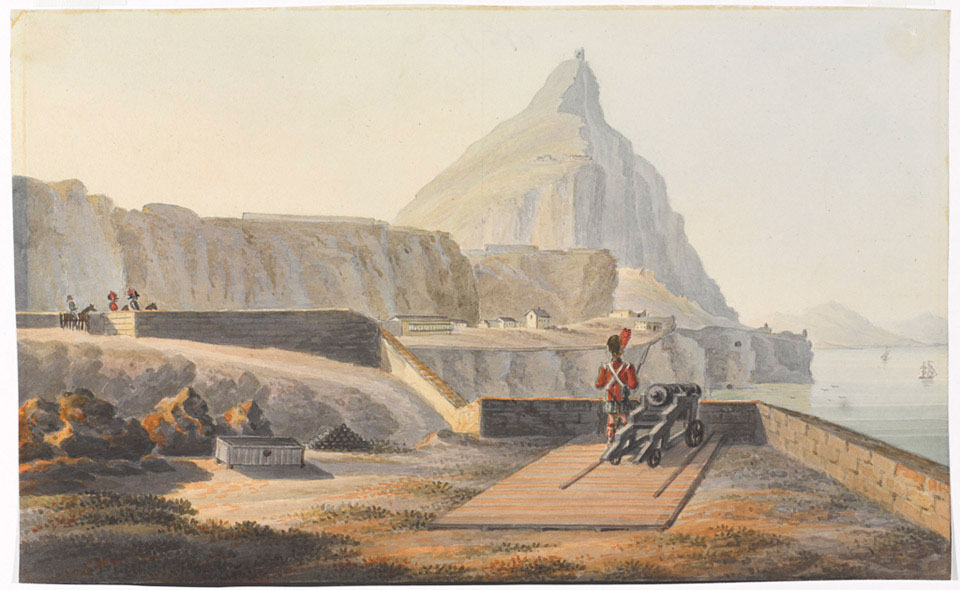
A view from one of Gibraltar’s batteries in 1827, as George would have seen it. The governor’s cottage is partway along the cliff in the middle distance, with the Rock of Gibraltar in the background (National Army Museum, NAM. 1999-04-21-1)
George remained in Gibraltar as lieutenant-governor until 1831, by which time he had been in active military employment of one sort or another for 62 years. In April that year the governor of Scarborough had died, and later in the year George was chosen to be his successor. About 76 by this time, he died on New Years Day, 1832, possibly of the flu. Still in Gibraltar, he was buried there in what is now the Cathedral of the Holy Trinity a few days later with full military honours. Alongside his role as lieutenant-governor, and his ceremonial colonelcies in multiple regiments, he had by this time been awarded with two knighthoods, as a Knight Grand Cross of the Order of the Bath, and a Knight Grand Cross of the Royal Guelphic Order.
All images of objects from the King’s Own Yorkshire Light Infantry Collection are shared under Creative Commons Attribution 4.0 International (CC BY 4.0), credit to Heritage Doncaster.