
The Kennedys
A lot of families have long traditions of serving in the armed forces, be it the army, the navy, or any other branches. This isn’t a recent trend, with some families going back generations, sometimes even in the same regiment. Recently our volunteers have been researching two soldiers, a father and son, who served in the regiment that would become the King’s Own Yorkshire Light Infantry. Both called Francis Kennedy, they served at times of great change in the army and in British life.
Francis Kennedy, the father, was born in Ireland in about 1788 to Robert Kennedy, a local gentleman. We don’t know a lot about his childhood but his family clearly had enough money to purchase an officer’s commission for him in the 51st Regiment of Foot in April 1809. At this time officers were expected to buy their ranks and they were expensive enough that most regular working people would likely never be able to afford one. Francis entered as an ensign, the lowest rank of commissioned officer in the infantry at the time.
Joining the army in 1809 meant that Francis could expect to either be sent abroad to defend territory across the empire, or to take part in the wars against Napoleon’s France, particularly in Spain and Portugal. The 51st had returned from Spain earlier in the year after the Battle of Corunna, the culmination of a chaotic and dangerous retreat through northern Spain in the winter. The summer after signing up the regiment was sent to Holland, as part of a British attempt to open another front to the war there. Francis took part in the capture of the town of Vlissingen, referred to as Flushing in English records. Called the Walcheren Campaign, many more men died from a disease that spread through the British army than were killed in combat, and this included the men of the 51st. We’ve no indication that Francis himself took ill, but the regiment lost many experienced soldiers, and in some cases recovery took years.
Becoming a lieutenant in 1811, Francis served with the regiment when it returned to Spain that year, taking part in many of the major battles of what was referred to as the Peninsular War between then and Napoleon’s surrender in 1814. He also fought at the Waterloo the year afterwards, serving through all this under a Captain Samuel Beardsley. In the years after the war he received the Waterloo medal, and a Military General Service Medal, both of which can be seen in our Research and Collections Centre within City of Doncaster Archives on Chequer Road.
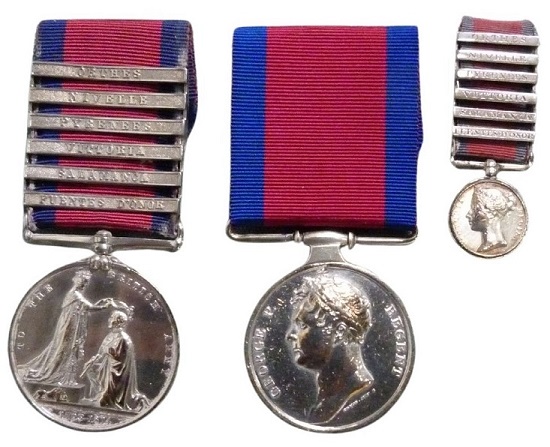
Military General Service and Waterloo medals of Francis Kennedy, two of the earliest medals issued by the British army. King’s Own Yorkshire Light Infantry Collection, Heritage Doncaster.
Francis retired from the regular army in 1824, after 15 years of service. He doesn’t seem to have been done with military life entirely however, as he very rapidly takes up an appointment as adjutant of the North Lincoln Militia the same year. This was an administrative job that broadly fills many of the roles a human resources department might in a civilian office nowadays. He later became captain of the militia as well, and held the role until 1853.
Outside the military, Francis married Elizabeth Charlesworth in 1827, in Lincoln. They had three children: daughters Frances and Emma and son Francis Charlesworth Kennedy. Elizabeth died in 1838 and Francis remarried four years later, to Frances Illingworth. He died suddenly in Lincoln in May 1857, aged 68, and was buried in Eastgate Cemetery. He received an obituary in the Lincolnshire Chronicle that read ‘he had the reputation of a gallant officer who was well known in the city as he had lived in Lincoln for more than thirty years’.
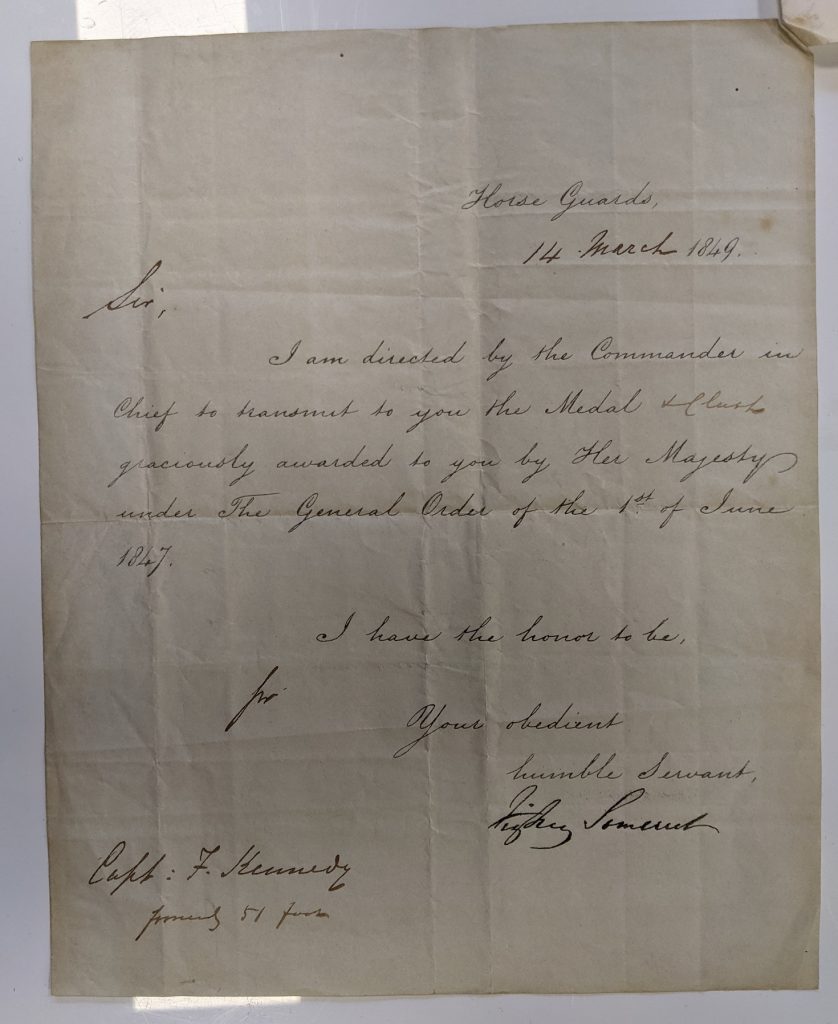
The Military General Service Medal was issued decades after the war that it commemorates. This letter to Francis comes from Lord FitzRoy Somerset, congratulating him for his service. Both men fought through the Peninsular War and at Waterloo. King’s Own Yorkshire Light Infantry Collection, Heritage Doncaster.
Francis’s son, Francis Charlesworth Kennedy, was born in June 1833 in Lincolnshire. Like his father, we know nothing about his childhood, but Francis Charlesworth did follow him into a career in the army. He became an ensign in the 51st at the age of 16, in September 1849, and by October 1851 he’d been promoted to lieutenant.
We know very little about these first two years of Francis’s military service, but in 1852 he’s part of the British forces deployed to Burma in the Second Anglo-Burmese War. In this war fighting with Burma (now Myanmar), broke out after British forces blockaded the Burmese port of Rangoon (now Yangon). After nine months of fighting the province of Pegu (now Bago) was placed under the control of the British-run East India Company. Francis was aboard an East India Company steam ship called the Sesostris during an attack on some Burmese positions along the Rangoon River. He was also present for capture of the cities of Rangoon and Bassein (now Pathein). For this he would eventually be awarded an India General Service Medal with a special Pegu clasp, offered to everyone who fought in that war.
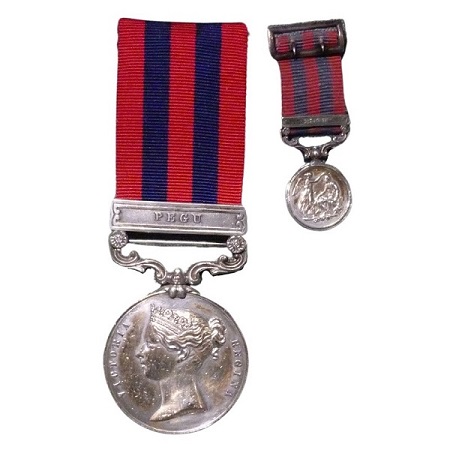
Francis’s India General Service Medal. By this point the practice was to use clasps on a medal to commemorate particular battles or campaigns. King’s Own Yorkshire Light Infantry Collection, Heritage Doncaster.
At this point Francis transferred into another regiment, the 43rd Light Infantry, based in Monmouthshire in southern Wales. 16 months later he transfers again, to the 25th regiment, who would come to be known as the King’s Own Scottish Borderers. There he advanced to the rank of captain, holding the rank for five years before retiring from the army in 1862.
Francis may have taken up many of his father’s social obligations after retiring as well, as he also becomes adjutant of the North Lincoln Militia at this time. A lot of his post-army life seems to have been spent living on James Street in Lincoln, where he and his family lived with multiple staff and servants. At its largest point the household consisted of Francis, his wife Julia, whom he married in Chepstow in Monmouthshire, their seven children Fanny, Francis Stanhope Appleby, Arthur, Julia, Emma, Bertha, and Gwendolin, and a live-in cook, housemaid, head nurse, and multiple ‘undernurses’. Another son, Francis Richard Stanhope, was born in 1864 in Kent but died in infancy.
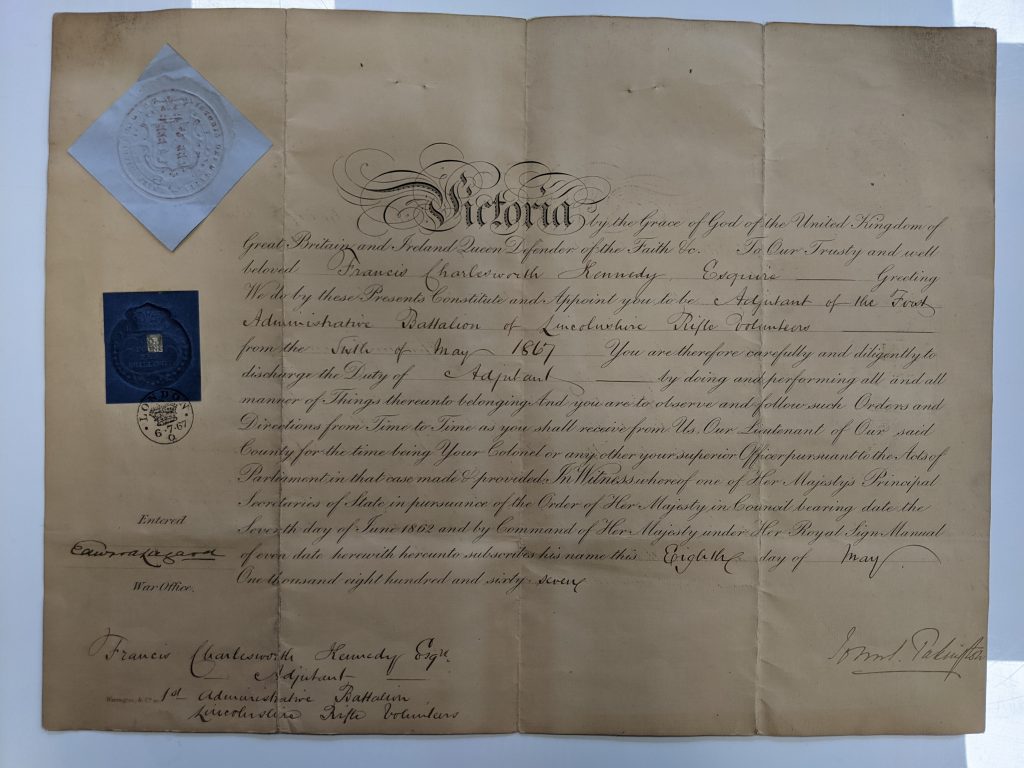
Francis Charlesworth’s commission certificate, recognising his duties as adjutant in the North Lincoln Militia. King’s Own Yorkshire Light Infantry Collection, Heritage Doncaster.
Francis Charlesworth Kennedy died in Lincoln on July 6, 1904, at the age of 71. Like his father, he was buried in Eastgate Cemetery. At this time all his children except for Arthur, mostly all adults, were still living in the family home at James Street. The research our volunteers have put in ends there, but we hope to continue looking into the family in the future.
Out of the thousands of men across the KOYLI’s history who’ve earned medals that are now on display, we knew that there were some fathers and sons. Some are fairly high-profile and have been the subjects of displays in the museum or blogs in years past, but for others, like the Kennedys, we’d only had the vaguest information about the. We weren’t even 100% sure that they were related before now! That we now know so much about two men, and have a good idea about their parents, wives, and children, not to mention their careers and homes as well, is a testament to the hard work our volunteers put in, and why we’re so excited about the stories coming out of the collection right now.
Our final KOYLI Research and Collections centre open day of 2024 is on Wednesday 11 December, 10am – 4pm. Come along and see the Kennedy medals, explore objects from our collection and learn more about the regiment’s history. You can always get in touch with us at [email protected] as well.
All images of objects from the King’s Own Yorkshire Light Infantry Collection are shared under Creative Commons Attribution 4.0 International (CC BY 4.0), credit to Heritage Doncaster.