
Christmas in the First World War
At the King’s Own Yorkshire Light Infantry Museum we’re well into Christmas mode. In the KOYLI Museum that often means thinking about Christmas in wartime, and for soldiers serving away from home. As well as the the Christmas-themed objects in the KOYLI collection. Some of the objects we explore in this blog may be familiar. You may even have them at home!
Christmas on the Western Front
We’ve all heard before the idea that the First World War would be over by Christmas, but of course we know that that wasn’t the case. As the men settled in for Christmas 1914 the war was still relatively young, and the front line hadn’t become bogged down and rigid yet. There remained, at least in part, a degree of good will amongst many British soldiers to their German counterparts. This is when the famous Christmas truce occurred. At many points along the British lines on the 24 or 25 of December men met in no man’s land and exchanged food, drink, words, and in some cases played football. However by 1915 things had changed, and Christmases over the rest of the war were often bleak affairs. Further back from the front there was often celebrations and Christmas meals, but in the trenches the holidays were often no different from any other time of year. This didn’t stop the men from recognising the holidays though, sending letters and postcards home, and receiving gifts as well.
Princess Mary Gift Tins
In the run up to that first Christmas, the 17 year old Princess Mary, daughter of King George V and sister of the future Edward VIII and George VI, wanted to pay for a gift for every soldier and sailor in the British armed forces. However it was eventually decided that she would back a public funding appeal to go out in newspapers across the country. The scheme ultimately saw the production of many millions of brass tins like the one pictured below. The contents changed depending on whether the receiving soldier was a smoker or not.
This one was gifted to Private Frank Carey, who served with the 12th Battalion of the KOYLI and died in March 1918. He clearly smoked, as his tin still contains the package of tobacco that it came with. It also came with a pack of cigarettes, photographs of the king and queen and Mary, and a postcard from her as well. The scale of the task of producing all these tins, combined with brass shortages as the war went on, meant that it took years to distribute all of the tins across the army and navy.

Frank’s gift tin with the tobacco and card from Princess Mary still intact. King’s Own Yorkshire Light Infantry Collection, Heritage Doncaster
Silk Postcards
A common souvenir bought by soldiers serving in France and Belgium was embroidered silk postcards. These were normally made by gluing a sheet of silk to a card and then embroidering images or messages onto that in turn. This was often work done by housewives and domestic staff as a way to earn a bit more money. Many soldiers would buy the cards to send home. Often they wouldn’t even write on them, as they were intended as mementos and souvenirs for the loved ones, when regular postcards or letters would do when the men actually wanted to write home.
One large set of cards we have come from a collection of objects belonging to Private Charles Hatcliffe Ellerby, from Barnsley. Charles joined the 2nd Battalion of the KOYLI before dying of wounds sustained in battle on 9 May 1915. Silk postcards were bought at all times of the year, but this one was sent home by Charles for Christmas.
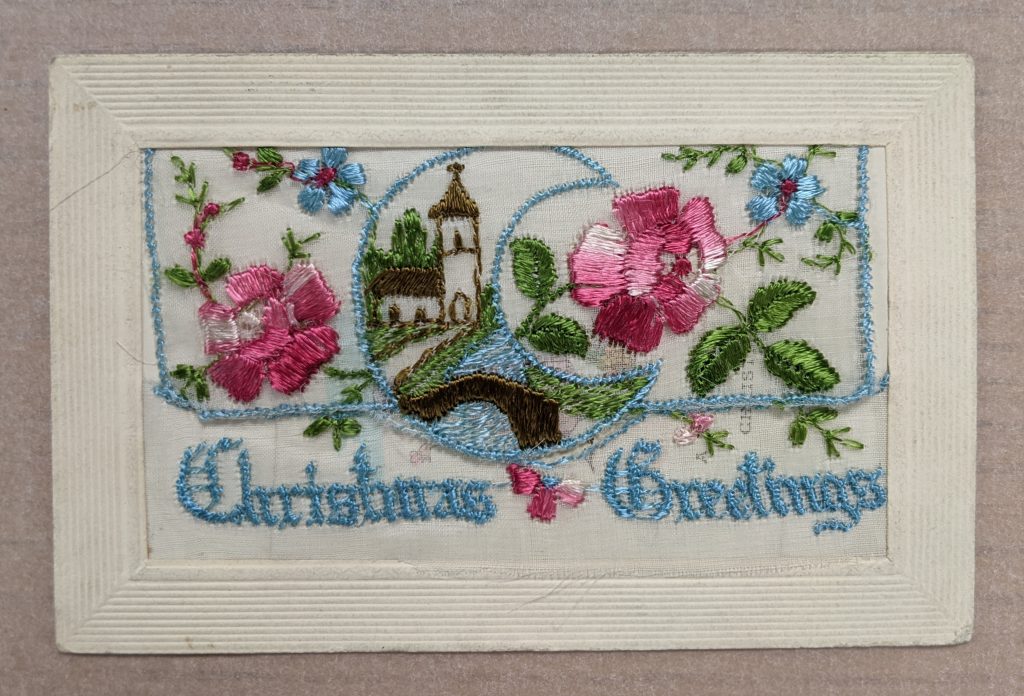
One of Charles Ellerby’s silk Christmas cards. This one wasn’t written on. King’s Own Yorkshire Light Infantry Collection, Heritage Doncaster
Handmade Cards
Often the most personal items we have in the collection are the letters and postcards set back and forth between soldiers and their families that they wrote or drew themselves. The words offer windows into the men’s lives and the lives of their families, and the drawings give them a touching intimacy that we often wouldn’t have seen otherwise, like these two from Walter Parsonage.
Walter was born in 1882 in Sandal, near Wakefield and had worked as a grocer’s assistant before the war, eventually managing a local Co-operative shop. When he was called to enlist in 1917 he joined the West Yorkshire Regiment. He’d married a woman called Florence, and together they had three children: Jack, Molly, and Nancy. After three months Walter transferred to the KOYLI and was sent to the front. In some of his letters that December he writes about Christmas, saying that he hoped for a lull in the fighting and that he missed the family very much. At some point Walter sent this card to his wife, whom he called Florrie.

Walter’s hand drawn card home to Florrie, including a poem written for her. King’s Own Yorkshire Light Infantry Collection, Heritage Doncaster
What we can be sure of is that this next card was drawn by Walter’s young daughter Nancy, sometime around Christmas 1917. She drew a Christmas pudding and included a list of ingredients, perhaps a recipe. The card is in very good condition, and it wouldn’t be hard to imagine Walter taking pains to take care of it while on the front.

Nancy’s card to her father, with a drawing of a Christmas pudding. King’s Own Yorkshire Light Infantry Collection, Heritage Doncaster
Walter was wounded in an explosion on 30 December 1917 and, while he was successfully moved to a field hospital, he never regained consciousness. He is buried at Potijze Cemetery near Ypres.
A Modern Army Christmas
Some aspects of a soldier’s life at Christmas haven’t changed in a hundred years. Many soldiers are still serving abroad or on operations in the UK on Christmas day, away from their families and friends. Many efforts are taken to make the men feel at home, with Christmas meals and sometimes carolling as well. Traditions that grew in the army are maintained, with some regiments serving a cup of gunfire, black tea and rum, to the men on Christmas morning.
Do you have any memories of Christmas in the forces? Do you have any Christmas cards or letters at home from family members who served? We’d love to hear from you. And whether you celebrate Christmas or not, we hope you have a wonderful holiday and New Year.
All images of objects from the King’s Own Yorkshire Light Infantry Collection are shared under Creative Commons Attribution 4.0 International (CC BY 4.0), credit to Heritage Doncaster.