
The King’s Own Yorkshire Light Infantry and Spandau Prison
The 1st Battalion King’s Own Yorkshire Light Infantry had two tours in West Berlin, in 1953/4 and again in 1967/8, carrying out many duties as part of their role guarding the UK sector of the city. One of these duties was guarding Spandau prison. Many of the details of the regiment’s time spent in Germany are shared in the regimental journal, The Bugle.
Spandau Prison was built in 1876 as a military detention centre and was turned over to the incarceration of seven leading Nazi war criminals after the Nuremberg Trials in 1947. It was the only prison managed collectively by the four powers. Berlin was partitioned into four separate sectors controlled by the UK, the USA, The Soviet Union, and France. It was surrounded by East Germany and the Soviet Army. Each country took it in turns to guard the Spandau prisoners, garrisoning it for three one-month periods per year. Despite tensions between the Allied powers and the USSR, guard duty was never interrupted.

The 1st Battalion arrived in West Berlin for their first tour of duty in March 1953 and stayed until August 1954. They were based at Wavell Barracks and were responsible for guarding Spandau in January, May and September each year, taking over from the American army. That, however, was by no means the biggest part of their duties.
When the battalion left Berlin the editorial in the The Bugle summed up their tour:
‘Berlin is a very good station for a short time, but a tour of 18 months is…long enough’, and ‘[we’ve] been able to concentrate on the training of the soldiers and the making of good NCOs. A lot of ceremonial, and with people of four nations watching, good drill and a smart turnout essential. Living in the middle of a heavily populated district, Spandau, relations with the public numerous and friendly.’
– The Bugle
One story that illustrates this well was from March 1954 when the people of Beverley, East Yorkshire, sent a pair of swans to the people of Spandau. There was a ceremony with local dignitaries where the swans were handed over by launching them onto the lake. The Bugle describes that Corporal Bailey and Private Hanby ‘stepped forward with the rather reluctant swans under their arms and launched them into the icy water’ One of the birds ‘returned to dry land only to be launched again immediately’.
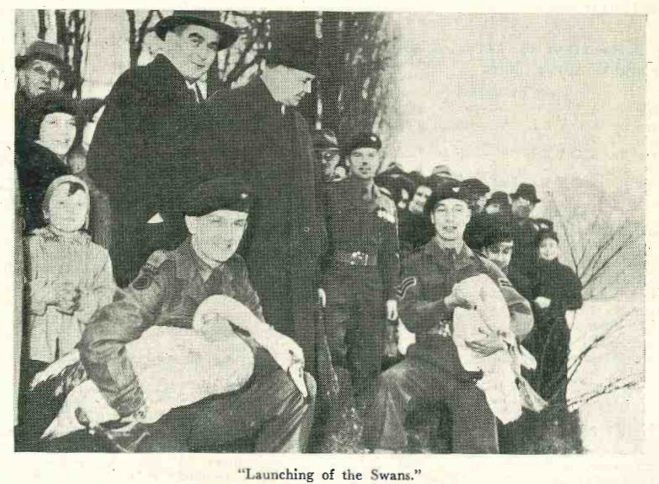
The Bugle 1953, Volume 46
However the Berlin Riots of June 1954 showed that there was real tension and danger in living surrounded by the Communist Bloc. The riots were anti-Communist and it soon emerged that West Berliners were not getting involved. However, after a few days of this the Battalion was on the alert and a company was dispatched into the city itself.
Peter Kitson, who was serving with the KOYLI at the time, gave a light-hearted eyewitness account of what happened in a York Press article in 2005. He said
‘Guarding the Spandau prisoners was very much in doubt that very evening, however – when we were suddenly told we were going to war against the might of the Russian army’…. So, on the night of the rising, the NATO response to the arrival in East Berlin of two Russian tank divisions (hundreds of tanks and 25,000 troops) was to mobilise the 600 men of the Kings Own Yorkshire Light Infantry. The result was obvious. News that the Yorkshiremen were waiting for the tank divisions spread fear through the Russian ranks and their senior officers decided they had better pull back from the brink, rather than face certain defeat! Within 24 hours the order came for the KOYLI to stand down. Armageddon had been postponed’.
– Peter Kitson
The Bugle confirms that they really were mobilized for war after several days of rioting. Thankfully early the next day a recce showed that things had calmed and the battalion was stood down that evening.
During their month on guard duty at Spandau prison soldiers would man the six towers around the prison as well as making sure that prison discipline was maintained. Although conditions had been deliberately harsh for the seven Nazis when they arrived in 1947, by the time the KOYLI were deployed there things had become considerably more relaxed. Prisoners were kept in individual cells but by now they were allowed to socialize, though it seems they had little inclination to do so. They were allowed to exercise and work in the yard, which was by then actually a small garden, and could have one visit of 15 minutes every two months. They could also write one letter a month and were allowed to read newspapers, though they were heavily censored.
The 1st Battalion returned to Berlin in April 1967, this time based at Montgomery Barracks, still in the Spandau district and even more closely overlooked by the Russian sector. In fact after the Second World War the Russians occupied this barracks until the British took over their sector. The battalion was there until July 1968, when they were renamed The 2nd Battalion, The Light Infantry.
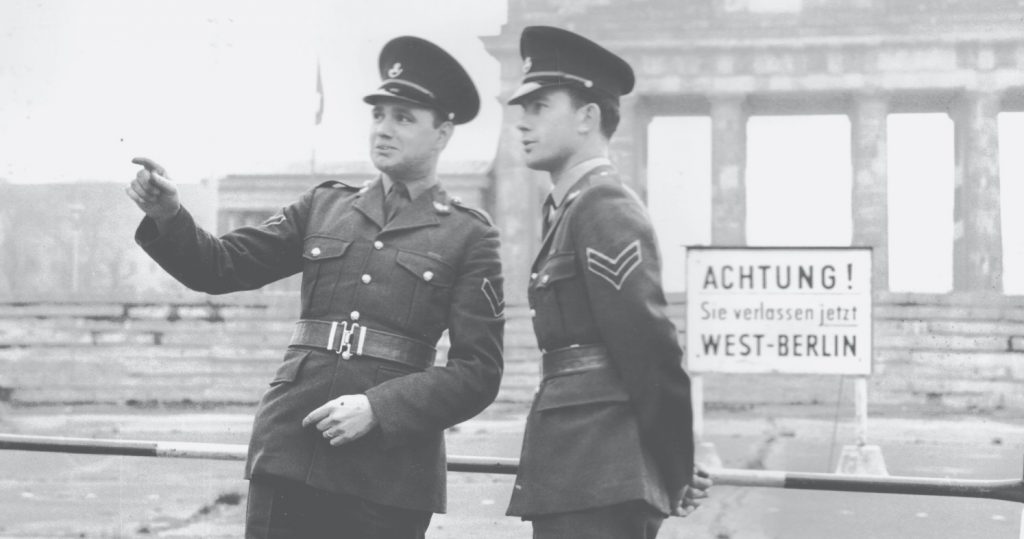
Their duties again were varied, ranging from training to daily tours into East Berlin in order to demonstrate their unlimited rights of access. The East German guards were not allowed to search the soldiers so they did their cursory checks of the vehicle very slowly. In September of 1967 Major Hutton was responsible for organizing the British Tattoo, with Lt Colonel Jiggs wielding the baton for 700 bandsmen. The Bugle said the Tattoo was bound to be a success with KOYLI men playing such important parts. And of course, it was.
By 1966 only Rudolf Hess remained in Spandau so the battalion was guarding just one man. Donitz, Speer and Schirach had served their full sentences, while Neurath, Raeder and Funk were released early due to ill health.
Duty was different this time. A bell was pressed at the impressive front gate, a warden would peer through a grille and if he was satisfied he would unlock the great door and let you in. By now the inside was in a real state of disrepair, the outhouses were completely ruined, mounds of rubble were everywhere and only one storey of the main building was now used. The soldiers could not understand why it took 27 men to guard the 73 year old inmate. It must have been a very strange place to guard. One of the six towers was reputed to be haunted, with stories of screams having been heard coming from it. However, the men still had the courage to man it. The KOYLI guarded the prison for ten days every four months, and it was not a popular duty.
When Rudolf Hess died by suicide on August 17 1987, that duty finally came to an end. After this death, the prison was demolished to prevent it becoming a neo-Nazi shrine. The rubble was spread in the North Sea.
Do you have any memories of the time spent guarding Spandau Prison? We would be interested in hearing from you. Please email [email protected]
This article was researched and written by project volunteer Lynda.