
42 Years with the King’s Own Yorkshire Light Infantry: Herbert Barker
Herbert Barker served with the King’s Own Yorkshire Light Infantry for 42 years, in a career that included everything from Bubonic Plague and a mule-driven machine gun to putting together a wartime concert band in trenches of the First World War.

Herbert around 1930, Regimental Journal The Bugle, King’s Own Yorkshire Light Infantry Collection, Heritage Doncaster
Born in Ravensthorpe in 1871, Herbert attempted to join the army multiple times in his youth, only for his father to buy him out each time, however by age 20 he successfully enlisted as a private with the 2nd Battalion of the King’s Own Yorkshire Light Infantry (KOYLI) in Pontefract. His early service was spent in the Channel Islands and Belfast, and Herbert was promoted first to corporal and then to sergeant, by the time he married his first wife Mary Ann Mann in 1897. Shortly after marrying, they travelled with the Battalion to Mauritius, a small island in the Indian Ocean. That same year, Mary died suddenly and was buried there. Herbert and the 2nd Battalion remained on Mauritius for the next two years, until they were transported to South Africa to take part in the Boer War.
Fought between 1899 and 1902 between the British Empire and the independent, Dutch-speaking South African Republic and Orange Free State, the Second Boer War was in response to British workers flooding the South African Republic after gold was discovered there. Political disagreements and violence between the Dutch and English-speaking settlers eventually spilled into formal war between the countries.
The British army struggled to adapt to the tactics favoured by the Boers, or Dutch settlers, and initially suffered a number of embarrassing setbacks. Huge mobilisations of men from other parts of the Empire slowly pushed the Boers back, and by May 1902 both countries were forced to accept British rule.
The 2nd Battalion KOYLI was present through many major battles and engagements in the war, having arrived soon after the war began in 1899 aboard HMS Powerful. There was some concern over whether they’d be allowed to disembark in the Cape Colony, as when they left Mauritius it was dealing with an outbreak of bubonic plague. Permission was eventually received however, and the Battalion got on its way.
Soldiers at Modder River in South Africa.
Throughout the war, Sergeant Barker was in charge of the 2nd Battalion’s machine gun team. A relatively new addition to the army at the time, the gun was the only one to support a Battalion of about 1000 men. Transported even in battle on a cart drawn by a mule, Herbert recalled years later that
‘I never received an order as to how or where the Machine Gun should take up a position and was usually left to my own resources… I generally found myself and Gun Team racing hell-for-leather in the Firing Line for the nearest piece of shelter likely to give cover for gun, carriage, mule, myself and three men‘.
Many years later, recounting his time in the war, Barker would submit a series of articles to the regiment’s magazine, The Bugle, about his experiences. It opened with a poem, pictured below. Herbert fought in two major battles during the war, the twin battles of Belmont and Enslin (sometimes called Graspan). Fought one day after another, they saw British forces making frontal attacks on entrenched Boer positions in the way of their march to relieve the siege of the city of Kimberley.
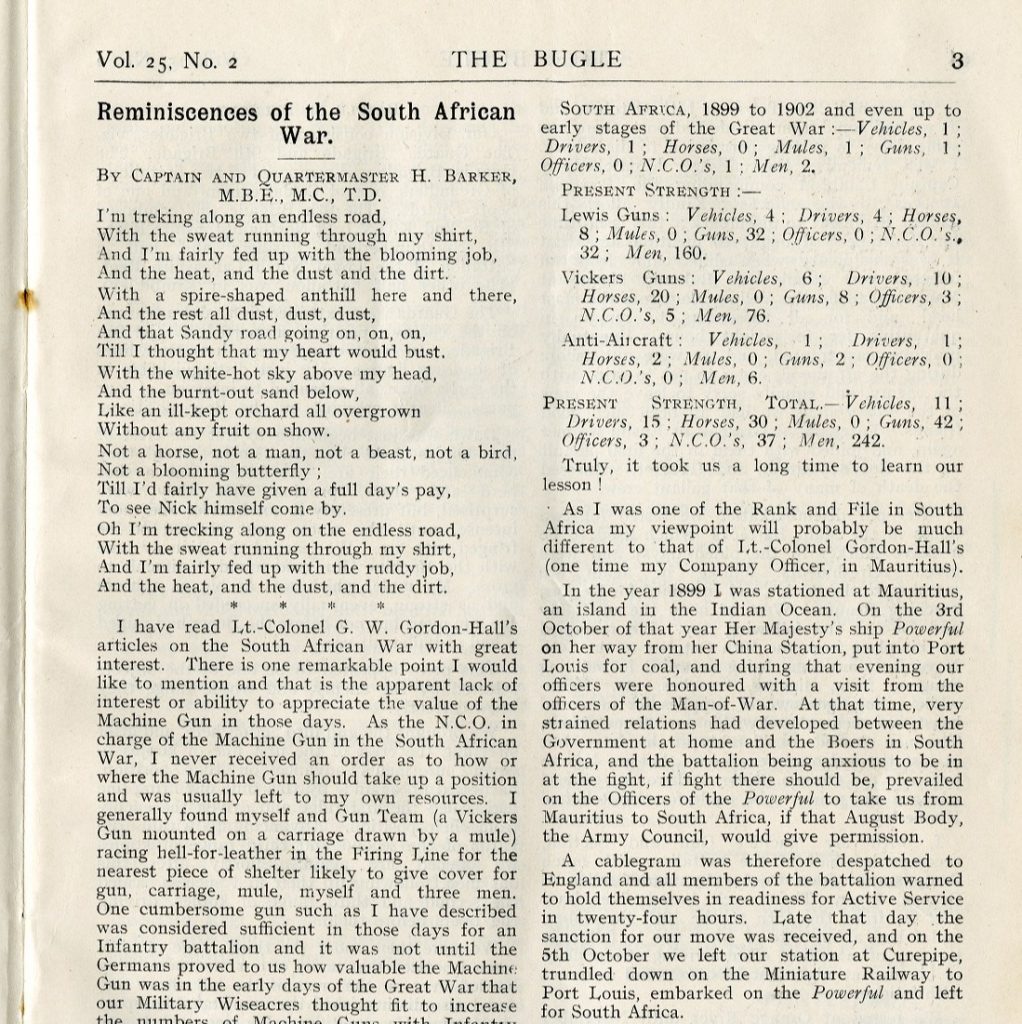
Herbert’s poem, published in The Bugle many years after the war. King’s Own Yorkshire Light Infantry Regimental Collection, Heritage Doncaster
After the end of the war the 2nd Battalion moved to Malta and then Crete. In 1903 Herbert was promoted to Colour Sergeant and married again, this time to Hannah Mary Barraclough. They settled in Doncaster and would go on to have 5 sons together.
In 1908 a new battalion, the 5th Battalion KOYLI, was formed, and Herbert joined as sergeant major. He’d go on to become the new Battalion’s quartermaster, who was responsible for stocks and stores, keeping the Battalion fit and equipped. It was traditional in the British Army that the quartermaster was a non-commissioned officer or a private, and that he would be promoted to a commissioned officer in the process. As such over his time as quartermaster, Herbert became lieutenant, captain, and then Major Barker.
The 5th Battalion spent most of the First World War in France, where Herbert received an MBE, and a Military Cross, both awards for gallantry. He was also mentioned in the despatches four times, which is a term used to describe a man’s actions in battle being reported by name to command. Through all this Herbert continued to see to his duties as quartermaster. In 1916 on Christmas Day, he apparently managed to see that the Battalion received a traditional Christmas meal despite wartime conditions.
Entertainment was often in short supply on the front, and during the war Herbert set up a concert band with men of the 5th Battalion, where he apparently made for a very convincing female impersonator for at least one performance.
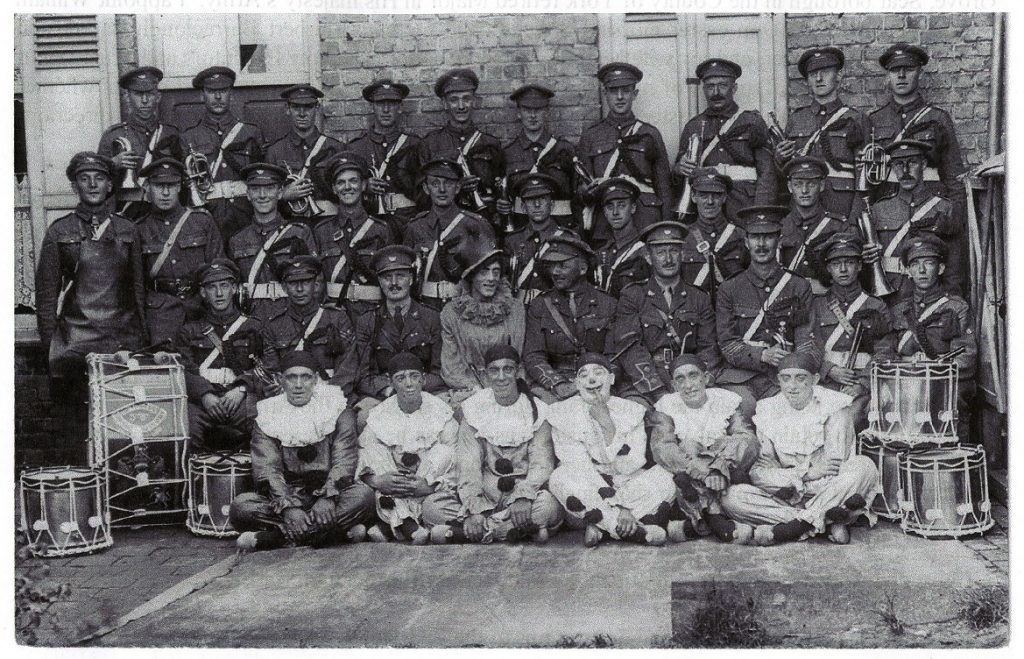
The concert band in 1917. Herbert is seated fourth in from the right, in the second row from the front. Shared by kind permission of Herbert’s family
Herbert remained with the Battalion after the end of the war, all the way until 1929. In this year Hannah died, and he retired after 42 years of service. With so many years in the KOYLI, Herbert’s farewell dinner was attended by men of all ranks, including many retired senior and serving officers from years past. He was presented with a large silver tray engraved with the names of all the officers present. The speeches made were all recorded in The Bugle and more than one man referred to him as one of the best quartermasters in the service.
Herbert spent 1930 travelling around the world and visiting family. This included two of his sons, stationed in the Middle East with the RAF. In 1931 he married for a final time, to May Parkinson, in Cantley. He came out of retirement in the Second World War to serve in the Home Guard, before retiring again. He died in 1955, aged 84, and is buried in a churchyard in Cantley.
All images of objects from the King’s Own Yorkshire Light Infantry Collection are shared under Creative Commons Attribution 4.0 International (CC BY 4.0), credit to Heritage Doncaster.