
Three Prisoners from the Second Battalion
In battle it isn’t unusual for some soldiers to be taken prisoner, and the King’s Own Yorkshire Light Infantry (KOYLI) was no exception to this. From the formation of its precursor, the 51st Regiment of Foot, to the KOYLI’s time in the First World War, men were taken prisoner. In this blog, we’re going to highlight three stories from the First World War.
The Battle of Le Cateau was fought in late August 1914 in northern France, and saw a British army trying to delay advancing German forces while the rest of the British Expeditionary Force retreated to safety. Some 2600 British soldiers were captured in the aftermath of the battle, including over 300 men of the 2nd Battalion KOYLI.
Lance Corporal Fred Singleton
Born in 1893 in Slathern in Leicestershire, Fred’s father had also served in the KOYLI, so it is perhaps not too surprising that Fred ended up in the regiment too.
By the summer of 1914 Fred was a Lance Corporal and a bandsman within the 2nd Battalion. Upon imprisonment he was sent to Altengrabow camp, a multinational PoW camp in central Germany. The facilities in these camps were often rudimentary, with poor hygiene and food that often didn’t provide enough nutrition to ward off hunger. Regular soldiers like Fred were put to work during the day as well, normally doing physical labour in or near the prison.
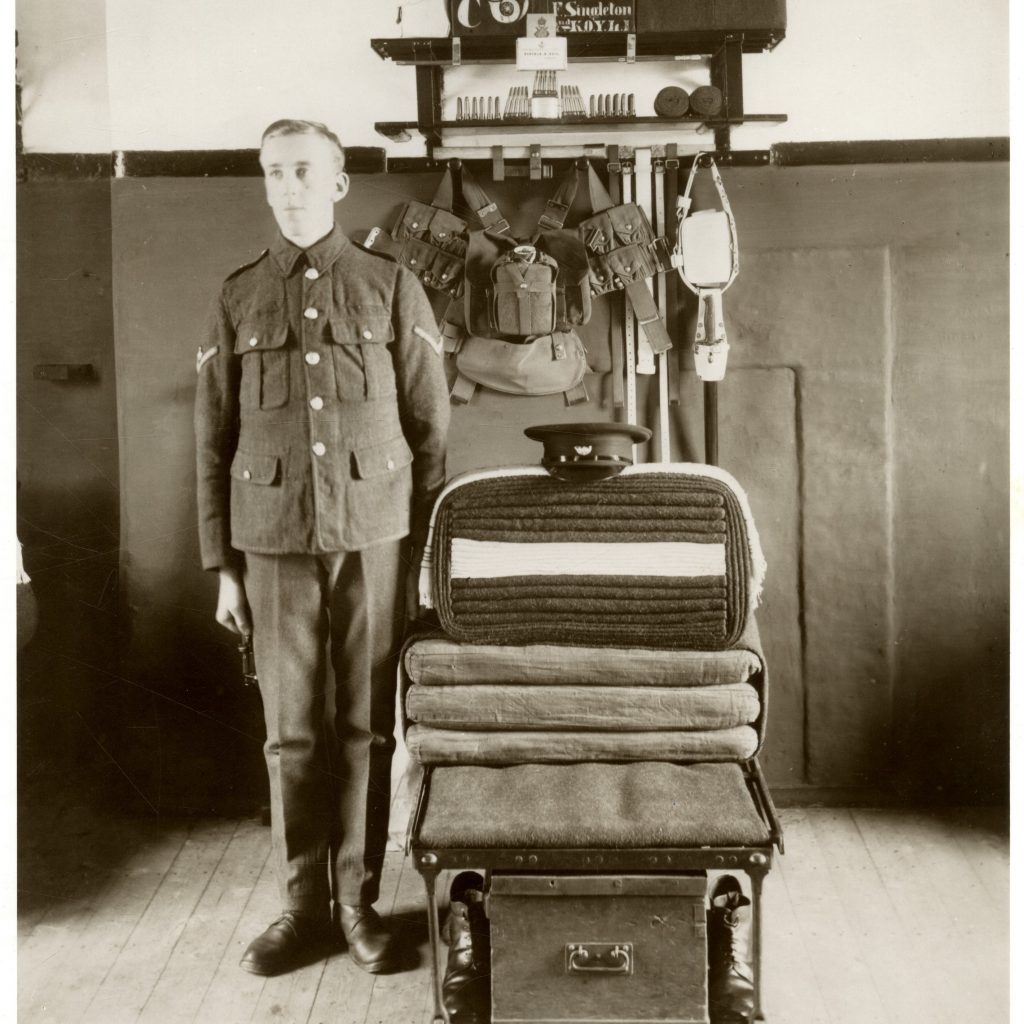
In Altengrabow Fred met the French actor and singer Maurice Chevalier. The story in Fred’s family is that it was he who taught Maurice to speak English. The two remained in correspondence after the end of the war. Fred had been seeing a woman called Liza before the war, and they continued to exchange letters even through his imprisonment. He ultimately survived the war and married her in 1923.
Major Charles Yate, VC
Charles Allix Lavington Yate was born in 1872 in Ludwigslust in Germany to a German mother and a British father. Charles grew up in England and joined the 2nd Battalion KOYLI after graduating from the Royal Military College at Sandhurst.

Yate’s military career took him first to Bombay, then to what is now Pakistan as part of the Tirah Expedition in 1897 and 1898. A year later the battalion transferred to South Africa to fight the Boers there, where he was seriously wounded in the fighting.
Well-travelled and speaking multiple languages, Yate was attached to the Japanese army as an observer in the early 20th century, and spent 1905 observing the Russo-Japanese war.
Though he was also captured at Le Cateau, Yate would be awarded the Victoria Cross for his actions there. The company under his command remained firing at the advancing Germans right to the very end of the battle to cover the withdrawal, and even charged at the enemy when their ammunition was exhausted.
Yate was committed to not being captured, having previously written articles claiming that no British soldier should even allow himself to be captured alive. Yate proved to be a violent and difficult prisoner. He had twice tried to escape while being ferried between different German headquarters over the next two weeks, and was eventually reunited with the officers of the 2nd Battalion at Torgau camp near Leipzig. Unwilling to wait for the end of the war, Yate made another escape attempt and died. There are conflicting stories about the circumstances of his death, with some reports stating that he was shot by guards during his escape, others state that he succeeded in escaping but drowned in a river, and others that he died by suicide to avoid being be recaptured. His Victoria Cross was awarded posthumously.
Lieutenant Colonel Reginald Bond
We’ve explored the life of Reginald Copleston Bond in a previous blog post. To hear about his experiences before, during and after the First World War, as well as the story of his wife Isabel, please do consider giving it a read. Here we’ll be talking a little more about Reginald’s experiences in prison at Torgau.
As the commanding officer of the 2nd Battalion in 1914, Bond was also taken prisoner in the aftermath of Le Cateau, and he would go on to write the book ‘Prisoners Grave and Gay’ about everything he experienced afterwards.
Imprisoned officers were afforded better conditions than the enlisted men (though they were no doubt unpleasant). They often had more space and better-built accommodation. For the most part they weren’t put to labour either, and, in camps where officers and men were held together, were often expected to liaise with prison management and organise the men for work. Otherwise boredom was a major issue as the weeks and months turned into years. Bond took up drawing and watercolour painting that he would continue with after the war ended.

A prisoner’s experiences could vary dramatically depending on his rank, behaviour, how he was captured, and what means he might have to support himself while in prison. Many men eagerly awaited care packages from home to see them through their imprisonment. It’s not surprising that many prisoners never spoke in detail about what they went through, and it remains an area of the King’s Own Yorkshire Light Infantry collection that we’re eager to explore more in the future.
If you’re interested in getting involved in research volunteering with us, please don’t hesitate to get in touch with us at [email protected].
All images of objects from the King’s Own Yorkshire Light Infantry Collection are shared under Creative Commons Attribution 4.0 International (CC BY 4.0), credit to Heritage Doncaster.