
Land of Perpetual Night – The KOYLI in Iceland 1940-1942
After the surrender of France in June 1940, the threat of German submarines in the Atlantic Ocean increased. Ships bringing equipment and food to Britain were targeted by German forces. To protect this shipping route, the 1/4th Battalion of the King’s Own Yorkshire Light Infantry (KOYLI) moved to an unlikely base: Iceland. Hugh Hibbert wrote recollections of his time spent in Iceland, describing how little the men of the regiment knew of the country. Some were familiar with it only from mentions on the shipping forecast, and many only had a ‘vague idea that it was a country of glaciers and icebergs.’

Another man in the 1/4th battalion, Private Leon Cooper, took many photos during his stay in Iceland. They appear in this article by kind permission of his family.

The Beginning
The battalion arrived on HMT Andes in late June, starting a tedious 2-year-long stay in the country. The regimental history of the KOYLI notes how unusual Iceland was for men of the regiment. Many of the men of the regiment were from industrial villages across Yorkshire. They were experiencing the snowy moutains, colourful houses, and the ever-present smell of seaweed and fish. The regimental history notes ‘Anything more different from the grimy towns of the West Riding it would be hard to imagine.’
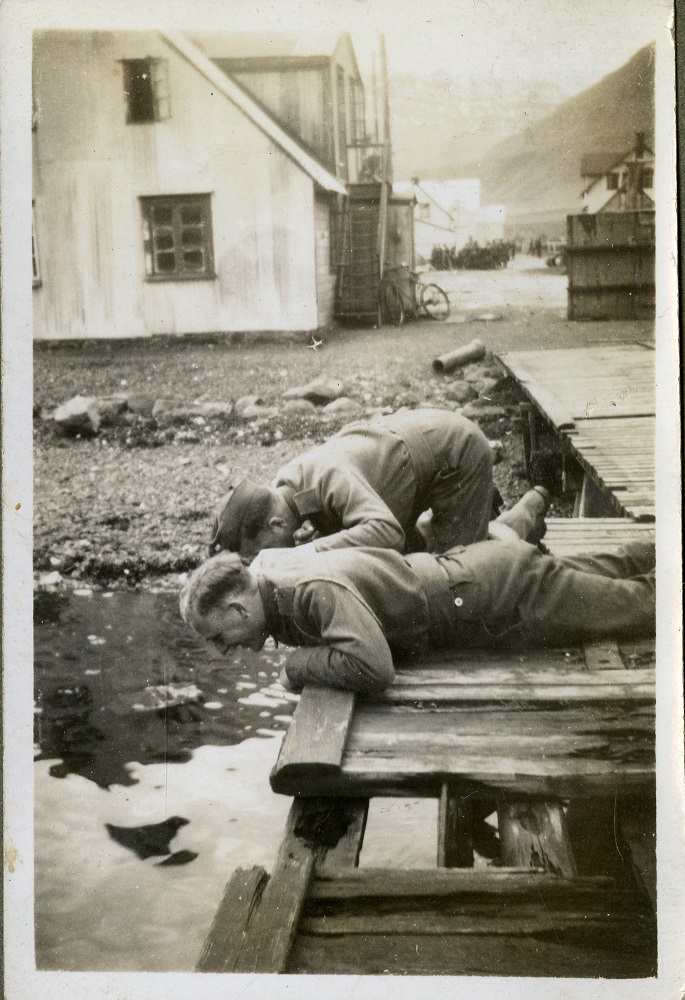
The conditions were in Iceland were a continual surprise to the men of the battalion. The regimental history notes of an instance of heavy fog allowing an Icelandic ship, the Esja, to loom up to the jetty. None of the soldiers based at the watching posts or action stations saw it approach.

Getting to Work
The main task of the battalion was to defend Iceland against enemy invasion. It was clear to the battalion that an area of 200 square miles could be defended from three points. Seydisfiordur, Reydarfjordur and Egilsstadir were the key locations. Hugh Hibbert and two companies held Seydisfjordur. “C” and “D” Company were at Budareyri, with one platoon watching a bridge at Egilsstadir.
The battalion’s priority was to set up as many defences as possible across the area. They wired the beaches and set up Bren gun positions. Soldiers positioned barrels of oil and petrol on the jetties, in case they needed to blow them up. Rocks and boulders from the rich landscape camouflaged operations from enemy forces. Men cobbled together anything they could find to cover their defensive posts. Men improvised tobaggons and sledges from scrap metal and competed to join new ski platoons. A keen concern for the officers during this time was the soldiers becoming “Maginot Minded.” This phrase refers to an over-reliance on defence and absence of offence during military planning.

The Environment
The spectre of winter hung over the heads of the battalion. Locals regaled them with the stories of blizzards, gales, frosts and total darkness. From the middle of November to the middle of February sunlight was very limited. Major Hibbert described Iceland as a land of ‘perpetual night.’ Providing sufficient light was a continual issue in the unsuitable Nissen huts and makeshift accommodation. This was not only a worry for defence, but also for the wellbeing of the men there.

Morale
While the lack of action could have been a relief, it often had the opposite effect. Unsurprisingly, long stretches of time without useful work would result in anxiety among the men. They could become preoccupied with worry about their homes and families. News of bombs falling on Northern towns would cause men to think of their wives, children, and families. Infrequent letters arriving by ship only exacerbated these concerns. Keeping the men of the 1/4th battalion fit, entertained and cheerful was a main priority. Soldiers organised informal education amongst themselves and kept busy with sports and competitions. They were entertained by concerts and singsongs and games staved off the boredom of the long dark nights.

Tragedy Strikes
In January 1942 tragedy struck the battalion. “B” Company set out to the mountains as part of a training exercise. A blizzard hit, dropping the temperature drastically, and reducing visibility. 8 men lost their lives to exposure and exhaustion.
- Lieutenant J E Bradbury
- Serjeant Calliss Cooper
- WO Class II Ernest Froggatt
- Lance Corporal James Goldsborough
- Private John Platt
- Private Arthur Rollinson
- Private Harry Moore
- Private Wilfred Gregory
rest together in Reydarfjordur Cemetery.

The End
After almost 2 years in Iceland, in May 1942 the KOYLI saw their first action. A large German aircraft few close to the water at Reydarfiord, circled Budareyri and flew back again. None of the eighteen rounds fired from an anti-aircraft gun hit the plane. And so, the only action seen by the KOYLI in Iceland ended.
In July 1942, the men of the KOYLI undertook training operations, and shortly after were relieved by American forces. In August, their time in Iceland came to an end.
This time is described in the regimental history as a time of ‘great discomfort, anxiety, and impatience’. Despite the challenges, men found solace in the quiet landscape of Iceland. Major Hibbert described it as an ‘escapist’s paradise’. He wrote that the disconnection of Iceland from the rest of the world took away the thoughts of war. It was ‘difficult to imagine that it [war] could possibly penetrate to such a peaceful spot.’ Many of the men of the battalion were working class lads from Northern England. They could never have dreamed of experiencing the sights of Iceland.
Although the time spent in Iceland by the 1/4th Battalion was very different to what men in other battalions of the KOYLI experienced, the time was not wasted. The regimental history states this time ‘may not have won the war, but it certainly ensured that Britain would not lose it.’

All images of objects from the King’s Own Yorkshire Light Infantry Collection are shared under Creative Commons Attribution 4.0 International (CC BY 4.0), credit to Heritage Doncaster.