
The Regimental Chapel of the King’s Own Yorkshire Light Infantry
9 May 2025 will mark exactly 100 years since the King’s Own Yorkshire Light Infantry chapel in York Minster was formally opened. To recognise this anniversary we wanted to write up a brief history of a chapel and a summary of what to expect if you ever decide to visit it in York.
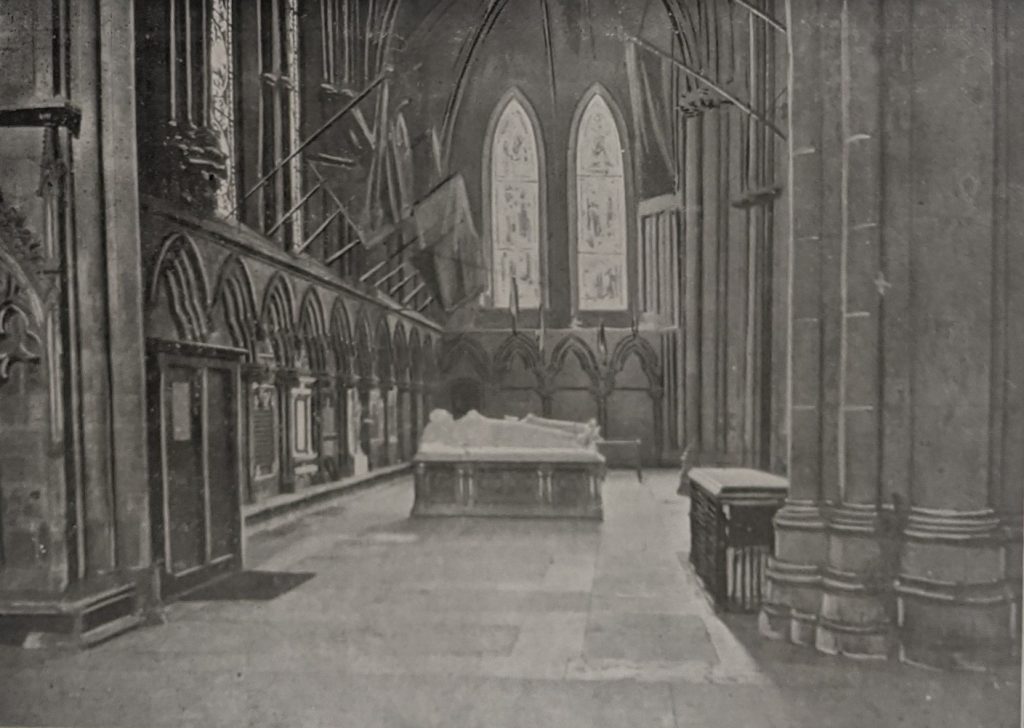
A rendition of the chapel from either the late 1910s or early 1920s before it took its modern form. King’s Own Yorkshire Light Infantry Regimental Museum.
Even though the chapel was dedicated in 1925, there had been memorials to the King’s Own Yorkshire Light Infantry (KOYLI) and its predecessors in the Minster going back to 1855. A memorial to those soldiers of the 51st Regiment of Foot who had fought in the Second Anglo-Burmese War was created in St. John’s Chapel, which is in the western aisle of the north transept of the minster. Other memorials were added in 1861 and 1888 and then in 1903 as well. In 1881 the 51st Foot had become part of the newly-formed King’s Own Yorkshire Light Infantry, so the memorials from then onwards were devoted to the new regiment. Interestingly, the memorials aren’t exclusively devoted to deaths in battle or at times of war. One remembered those men of the 51st that had died in an 1861 cholera outbreak in Mian Mir, also called Meean Meer and now part of Lahore in Pakistan.
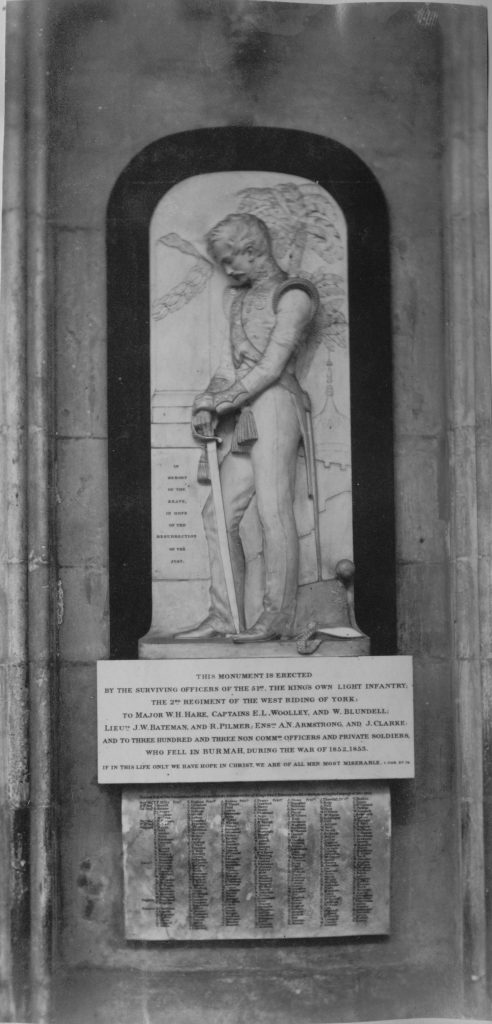
Photograph of the Second Burma War Memorial. King’s Own Yorkshire Light Infantry Regimental Museum.
Aside from the dedicated memorials, since 1899 the space had also been home to several regimental colours. The colours are the ceremonial flags of the regiment that they had carried into battle. By 1899 they weren’t taken into battle anymore but still served as a ceremonial symbol of the regiment at important events. However once a set of colours reached a certain age, they were officially ‘laid up’. This was a retirement ceremony for the colours themselves, but also a chance to remember the history of the regiment itself and the soldiers who served in it. As part of the ceremony the colours were hanged up and left to decay naturally over time. In York Minster a guide was eventually added detailing which colours were which and when they were in use by the regiment.
Over the 1800s and early 1900s more memorials were added, commemorating different campaigns and events. In the years after the First World War discussions began in more detail to formally devote St. John’s chapel to the KOYLI. An iron fence was installed to separate the space from the rest of the minster and decorated with the names of well-known battles and campaigns that the KOYLI took part in. This fence cost about £5000, and was paid for through donations from serving and retired soldiers in the regiment.
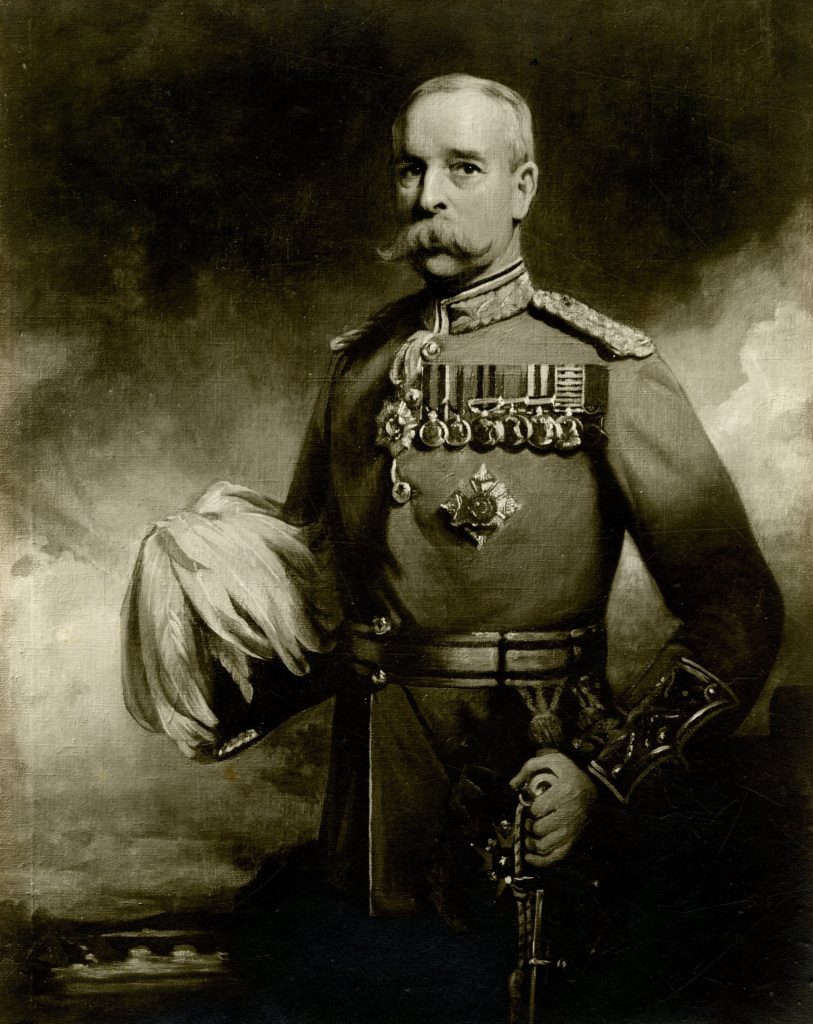
Sir Arthur Wynne, colonel of the KOYLI in 1925. King’s Own Yorkshire Light Infantry Regimental Museum.
The actual ceremony to dedicate the new regimental chapel took place on 9 May 1925, 100 years ago next month. The dedication ceremony was presided over by Cosmo Gordon Lang, Archbishop of York, and General Sir Arthur Wynne, KCB. Sir Arthur was the colonel of the KOYLI at the time and was 78 years old. He’d joined the 51st Foot in 1863 at only 17 and had remained involved in the army for his entire life. Copies of the full programme from the day remain, including the speeches made by the archbishop, the colonel, the Bishop of Wakefield, and more.
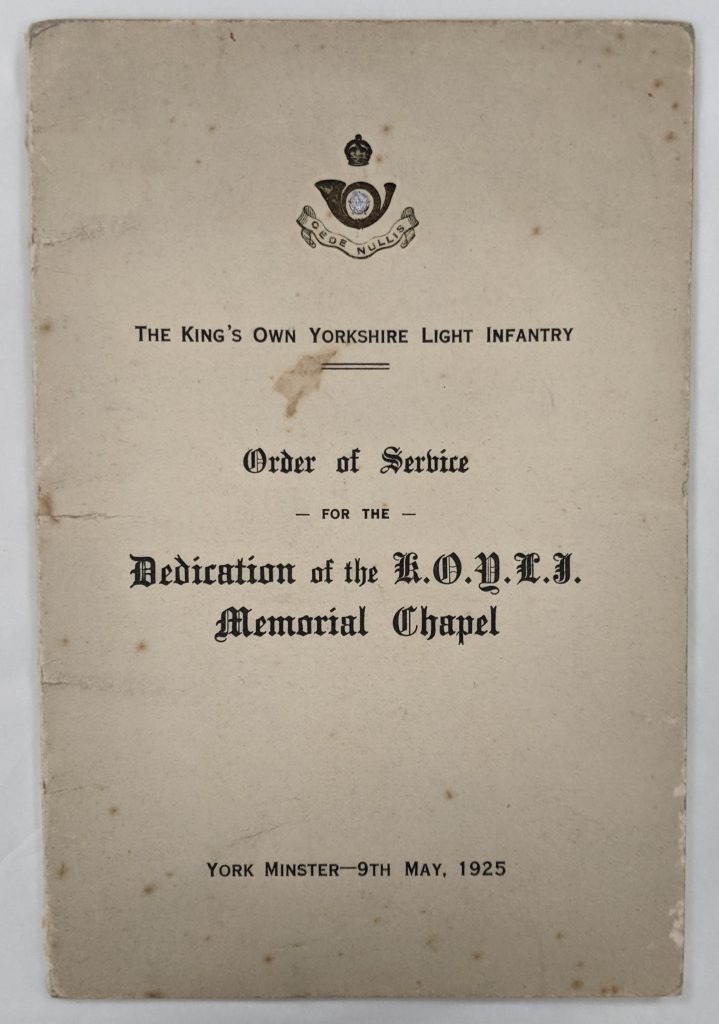
One of the original programmes from the dedication in 1925. It contains the hymns and details of the service, together with the speeches given. King’s Own Yorkshire Light Infantry Regimental Museum.
Over the decades further changes have been made to the chapel, including multiple memorials to groups and individuals. Perhaps most important is the book of honours, which records the names of all the soldiers of the King’s Own Yorkshire Light Infantry to have died in both the world wars. One memorial is dedicated to every soldier of the 51st that died in the Peninsular War (1808-1814). It also includes a bust of Sir John Moore, one of the 51st’s most famous soldiers. Gifts have been exchanged back and forth with the minster over the last century, such as a full copy of the regimental histories which we believe York Minster still has today. The regiment also paid for restorations of parts of the minster itself in turn, such as when they had some six- to seven-hundred-year-old stained-glass windows restored in 1947.
The chapel also contained several of the Freedoms of the Boroughs awarded to the King’s Own Yorkshire Light Infantry after the Second World War. These were on display in the chapel for a number of years before returning to the regiment. They moved between several sites before being moved to the museum in the 2000s. They’re now on display in our Research and Collections Centre, and were the subject of an earlier blog, which you can read here if you’d like.
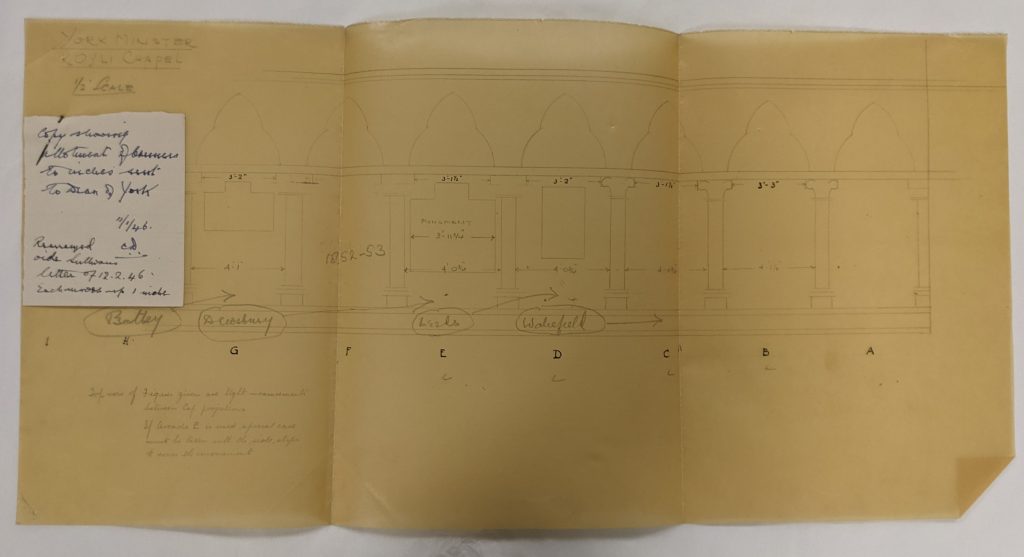
A copy of an architectural plan from the 1940s, with notes about where each of the Freedom scrolls was to hang. King’s Own Yorkshire Light Infantry Regimental Museum.
Today the chapel is still open to the public, and the content has been expanded to recognise the KOYLI’s amalgamation into the Light Infantry and then the Rifles in the 1960s and 2000s. Adults who don’t live in York itself must pay to enter the Minster, but within the Minster the regimental chapel itself is free to enter and regularly hosts events and memorial services.

© Paul Cooper (WMR-30510)
Have you visited the regimental chapel before? If you’d like to get in touch with us please email [email protected] You can also get in touch through the Danum Gallery, Library and Museum’s social media as well.
All images of objects from the King’s Own Yorkshire Light Infantry Collection are shared under Creative Commons Attribution 4.0 International (CC BY 4.0), credit to Heritage Doncaster.