
Perky the KOYLI Panther
The new King’s Own Yorkshire Light Infantry Research and Collections Centre in the City of Doncaster Archives contains a complete run of The Bugle, the King’s Own Yorkshire Light Infantry’s regimental magazine. It was mostly released quarterly until 1968, and contains everything from regimental news to sports results, short stories, and reminiscences from retired soldiers. One of the more unusual, and detailed, stories is an account from the September 1937 issue, regarding the recent efforts of officers in the 2nd Battalion, stationed in Burma, to raise a panther cub to adulthood.
The 2nd Battalion had arrived in Burma in 1936 and was largely stationed around Maymyo. This is a town now called Pyin Oo Lwin, not far from the city of Mandalay. The battalion was present as part of the escort for the Burma Boundary Commission of 1936-7, which set out to identify the borders between Burma, then part of British India, and China. The author of the article in the Bugle was identified only as “ARF”.
ARF recounts the Commission’s travels through Burma, before saying “We arrived in Lashio, which was the base camp for the Burma Boundary Commission, in the middle of December 1936”. The only animal present in the camp was a dachshund named Dinah. The author lived in a matting hut with a thatched roof, which he claimed reminded him of Robinson Crusoe. One afternoon, just before Christmas, a local arrived with a roughly four-day old panther kitten, found in the jungle. It was believed to have been abandoned by its mother, and the officers of the camp bought it.
The kitten was discovered to be a girl, and the men set out working out how to nurse her back to health, settling on a drop of whiskey on a teaspoon and half and warm water, fed to her while resting in front of the fire. Once she woke up they fed her cow’s milk diluted with warm water. Again, she was fed with a teaspoon, and every two hours in the first night. Eventually she was able to swap to a baby’s bottle, but the teaspoon remained for now.
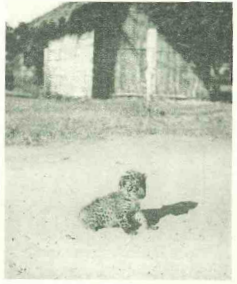
The new arrival
After about a week she perked up considerably, and was christened ‘Perky’. On cold nights Perky slept with a hot water bottle, to mimic the warmth from her mother. She became very friendly with the dog Dinah. Initially concerns were raised over her eyesight, but this cleared up after three weeks, and she became much more mobile.
Perky and Dinah weren’t the only animals around the camp. ARF recalls “Cattle frequently grazed in and around our compound, and we managed to tame one calf, which arrived every morning at breakfast time to receive the remains of the toast which were left. On one or two occasions it forced its way into the hut; this was not encouraged. From the very beginning, Perky took a fancy to this calf, and on many occasions the calf lowered its head to lick Perky”.
A playpen was built for her eventually, but she required more watching as she got stronger, being found more than once lying on one of the officer’s beds, having happily destroyed a shoe or some item of clothing. From about three months of age small amounts of meat were introduced to her diet. After some hesitancy Perky took to it, as well as lapping at water from a bowl. Nightly milk was still only acceptable when presented in a bottle, however. She was regularly taken out on short walks around the camp as well, and apparently was very much the one in charge of the route taken.
Eventually the Commission moved to Maymyo proper on the train, with Perky being moved in a dog’s cage. A kennel was acquired for her and placed on the veranda of one of the officer’s houses in Maymyo. ARF claims she found the garden very attractive, regularly lying by the flowerbeds and systematically batting at and then biting the heads off the flowers there. When she moved on to rolling through the flowerbeds a plan was devised to take her on frequent walks around the local jungle to tire her out. Once the rainy season arrived her playpen was rebuilt in the stables.
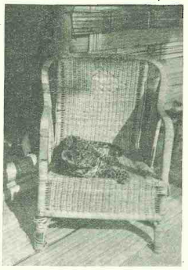
Perky lounging.
By July Perky was becoming larger and harder to control. On walks she regularly bounded up to people and nipped them with her teeth. At this point it was decided that she ought to be on a lead, implying she hadn’t been put on one on any walks previously!. The ‘walks’ often involved her climbing trees and running laps around her handler that day. She soon became familiar with the routine, and resented being returned to the enclosure, though she never reacted poorly to being played with inside it, or even being stroked while eating. As the article says, “in her enclosure she can be as gentle as a tabby cat, although at time, not above having a nip at the fleshy part of one’s leg. When out on the lead, she can be absolutely devilish, and not for one second is it advisable to have one’s eyes off her”.
As summer continued, she became harder and harder to manage, and as of the writing of the article in the Bugle, some time before September 1937, the Battalion was waiting for arrangements to be made to have her moved to Rangoon Zoo. The Battalion expected to move nearer to Rangoon eventually anyway, and the article expressed hope of seeing her in her new accommodations there in time. Through this entire process the Battalion also acquired a Slow Loris (a kind of nocturnal primate). ARF signs off the article with “Our visit to Lashio provided us with two most unusual pets, and their habits and reaction to various forms of treatment have been a most interesting study.”
All images of objects from the King’s Own Yorkshire Light Infantry Collection are shared under Creative Commons Attribution 4.0 International (CC BY 4.0), credit to Heritage Doncaster.