
The Last Day of the First World War
The First World War affected almost every part of British life, and its impacts are still felt today. It unsurprisingly led to huge changes in the armed forces and The King’s Own Yorkshire Light Infantry (KOYLI) was no different in this respect. On 11 November 1918 armistice was signed. But what were soldiers of the KOYLI doing on this exact day 106 years ago?

Many recruitment events and charity drives and parades were held throughout Doncaster during the war, with the aim of drumming up support for the different branches of the armed forces. (18-MIL, Local Studies Library, City of Doncaster Archives, Heritage Doncaster).
At the start of the war the battalions of the KOYLI were stationed around the world. The 1st Battalion was in Singapore and the 2nd Battalion in Ireland. The 3rd was a reserve battalion, and the 4th and 5th were what were Territorial battalions, which served at home. Territorial soldiers were sometimes called ‘Saturday Soldiers’. Over the next year this they added 11 more. Even though many of them were reorganised or disbanded and the actual number at the end of the war was lower than 16, the regiment had still more than doubled in size. Some battalions, like the 4th, were split into two, being named the ‘first fourth’ and ‘second fourth’. These are traditionally written out as 1/4th and 2/4th, which is how we refer to them in the museum.
By the autumn of 1918 the war had spread across the world, though the KOYLI itself had no men outside of Europe by November. There were 12 Battalions in the regiment by the end of the war, and many had had very different experiences of the war. The 2nd Battalion, for example, had taken more than half its numbers as casualties or prisoners in 1914, forcing the Battalion to rebuild itself. By the last day of the war, it, together with the 1st, 1/4th, 2/4th, 5th, and 9th Battalions were stretched across one 15-mile section of the British frontline, waiting for the armistice to come into effect. The 9th Battalion war diary notes that although ‘inward satisfaction’ was felt, ‘no outward demonstration was made’. Once armistice came into effect, most of the Battalions slowly received orders to return home. Their return was staggered so they weren’t all sent home at once.
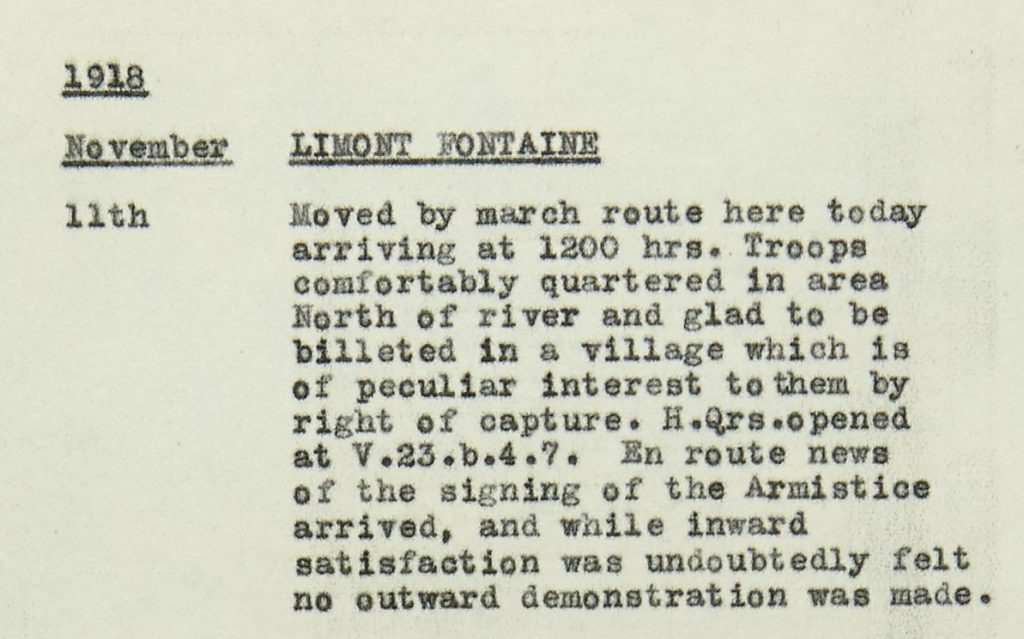
However, the 2/4th and 5th KOYLI were ordered into Germany as part of the army of occupation. Even in 1919, it wasn’t certain that peace negotiations would continue, and the 5th Battalion received secret orders regarding the possibility that fighting could restart.
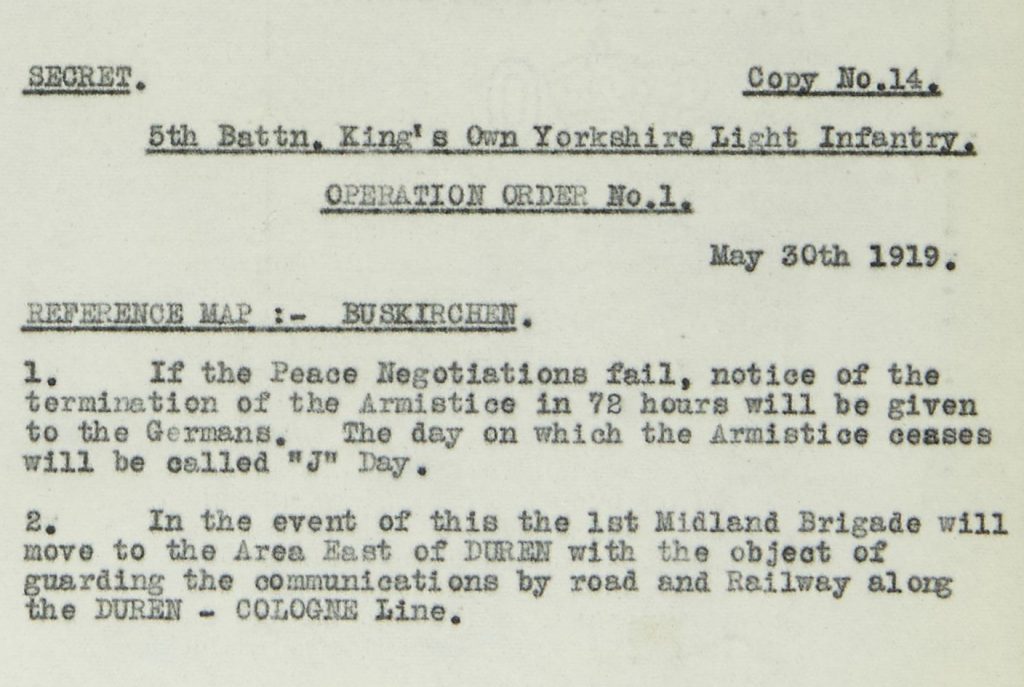
Part of the secret orders given to the 5th Battalion in May 1919, in case the war restarted while they were still in Germany. 5th Battalion War Diary, King’s Own Yorkshire Light Infantry Regimental Collection, Heritage Doncaster.
The 3rd Battalion meanwhile, had a very different experience of the war. Originally containing reserves, they had formally remained in the UK during the war, while individual men were transferred out in groups to fill gaps in other battalions. Originally based in Pontefract, the 3rd moved to Hull at the outbreak of the war, to defend the coast in case of an invasion that never happened. They were still there when the war ended.
For the 8th Battalion, the end of the war was spent in northern Italy, where they had been fighting against the Austro-Hungarian army. Hostilities had paused here on the 4 November, not the 11, and the 8th Battalion spent the week between the two dates moving between multiple towns and villages as was required of them. On the 11 November itself, they were in a village called Cendon, about 20 miles north of Venice. As with the Battalions in France and Belgium, the end of the fighting didn’t mean they were sent home immediately. In this case they didn’t set out for the UK again until the 23 December.
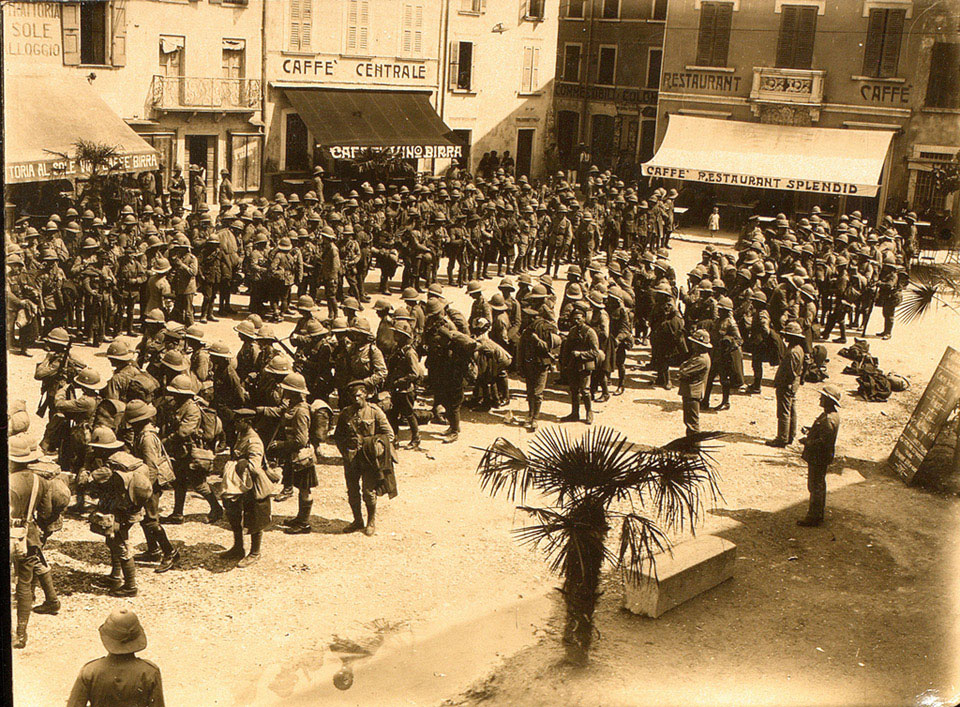
British forces, including 8 KOYLI, arrived in Italy late in 1917 (NAM. 2004-06-91-2-7).
The 12th Battalion had seen combat only ten days before the end of the War. On 1 November they had been involved in a push to recapture the city of ‘Audenarde’ (now Oudenaarde) in Belgium. They spent the actual final day of the war moving between accommodation in the village of Orroir to the city of Renaix (now Ronse). According to accounts of the time, they were ‘finding billets there in houses and schools’ as they were able to find room for all the men. By the end of November they’d pulled back to France however, and on the 12 December they received orders to return home and demobilise.
Other battalions left far smaller impacts in the regiment’s collections here in the museum. Early in the war an 11th Battalion was raised. Initially another reserve battalion, it was converted to a training battalion, which only existed to receive new recruits and train them to an acceptable level for service in another battalion. With this conversion though, it became unaffiliated with the KOYLI, and largely passes out of our records. The 14th had been devoted entirely to home service, also never leaving the UK. It disbanded in April 1918, by which time the decision had been made to scale back the number of men under arms within the UK. Finally, the 16th Battalion were exclusively a garrison battalion, with various duties at home.
Regardless of what each man saw in the war, they returned to the same country. However, Britain was in many ways a different place in 1918 and 1919. Life had changed to accommodate the needs of the war, and would continue to change as the nation grappled with the impact of so many deaths. Many soldiers also couldn’t or chose not to talk about their experiences with friends and family who hadn’t seen military service. As a result, we see waves of regimental associations, veteran’s clubs, and groups like the British Legion emerging in the years to follow, and many still exist today. These were places where veterans could honour their comrades and share their experiences with people who’d been through similar things to them. This time of year, many hold remembrance services and events across the country, which have often grown beyond just remembering the First World War, and into events that commemorate those who died in service across the UK’s history.
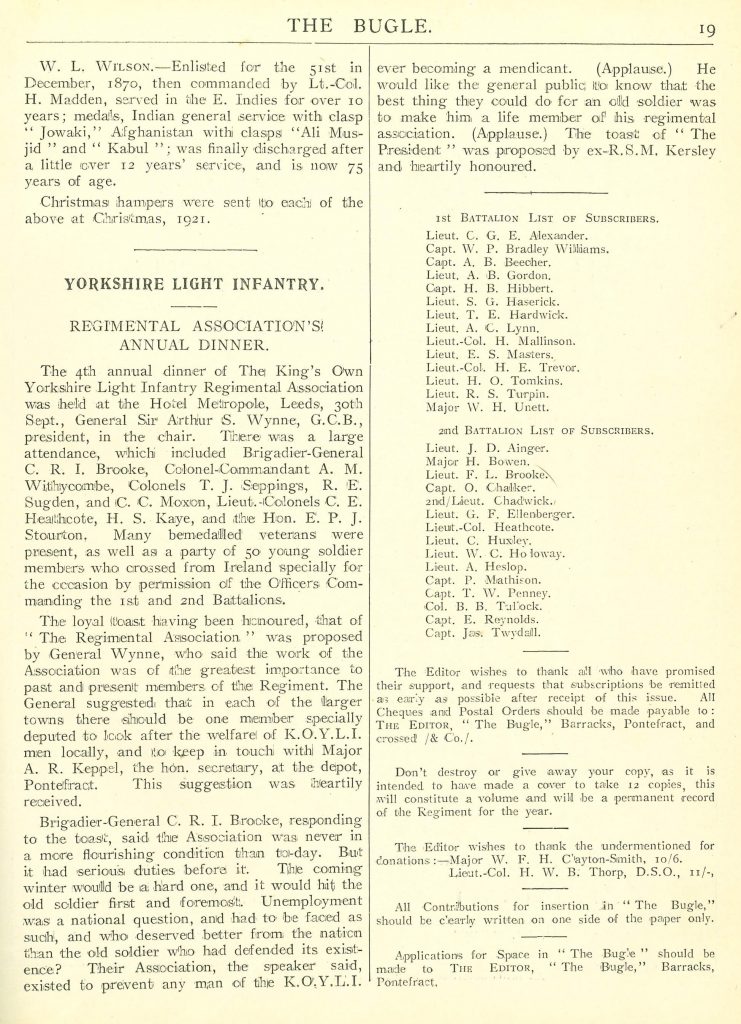
The KOYLI Regimental Association formed in 1918 and championed the causes of old KOYLI soldiers across the country. The Bugle KOYLI regimental journal, King’s Own Yorkshire Light Infantry collection, Heritage Doncaster.
Did you have family who served in the First World War? We’d love to hear how you or your community remember them and the war, and whether that has changed over time.
All images of objects from the King’s Own Yorkshire Light Infantry Collection are shared under Creative Commons Attribution 4.0 International (CC BY 4.0), credit to Heritage Doncaster.