
Reginald and Isabel Bond
The majority of the medals in our collection belong to the men who served in the King’s Own Yorkshire Light Infantry (KOYLI). A more unusual part of the collection is a set of medals belonging to a woman with a relationship with the KOYLI.
Isabel Bond was the wife of Reginald Bond, an officer with one of the most unusual stories from the KOYLI in the First World War. As such we know quite a lot about him. Meanwhile, information on his wife is quite limited, and she has been an ongoing subject of research over the last couple of weeks.
Reginald Copleston Bond commanded the 2nd Battalion of the KOYLI at the outbreak of the First World War. He was born in 1866 to Frederick and Mary Bond in Marlborough, a market town in Wiltshire. After attending Trinity College in Oxford he joined the KOYLI.
Reginald served in Pakistan, South Africa and in the UK. During the Boer War he was mentioned in the dispatches.
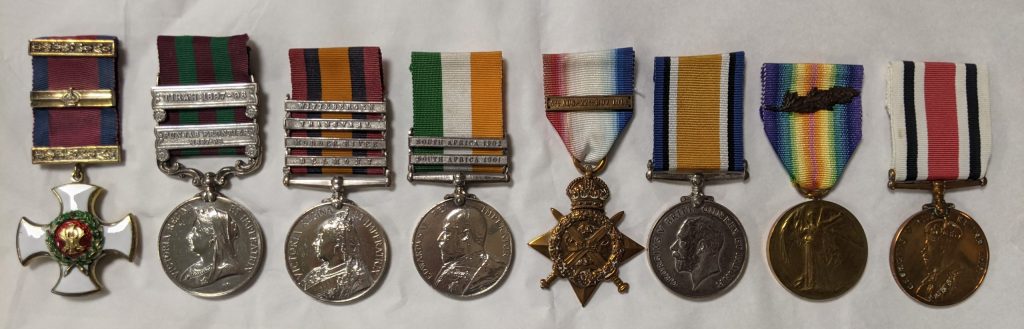
In 1914 the now Lieutenant Colonel Bond was commanding the 2nd Battalion of the KOYLI. On 26 August 1914 several hundred men from the battalion were captured during the battle of Le Cateau, with Bond amongst them. He spent the rest of the war in German captivity, writing the book ‘Prisoners Grave and Gay’ detailing his experiences.
While imprisoned in Torgau camp in eastern Germany several men of the KOYLI, including Bond, had been reported as being killed in action. The group were permitted to send a cheque with donations to the Red Cross back to the UK. Written on the cheque the officers asked the bank to notify each of their next of kin about the transaction. As many of the men had been declared as killed in action, this was the only way they were able to notify their families that they were still alive.
Reginald Bond returned to the UK in 1918 and left the army the next year. He continued to be an active part of the regiment and wrote the official history of the regiment for the First World War. Reginald died in 1936.
This is only a portion of what we know about Reginald as he appears in many of our regimental records, but what about Isabel? Born Isabel Maud Tyler, she was the daughter of T. B. Tyler, who was Inspector-General of Artillery in India in 1897. This year, Isabel married Reginald. Reginald was serving in India at the time, so it seems likely that this is where they met.

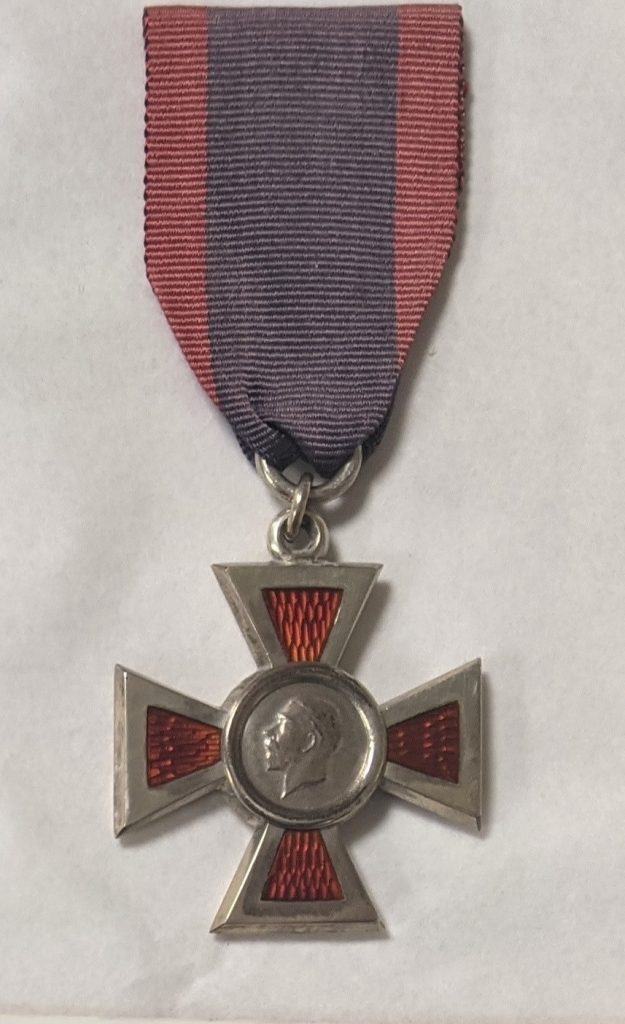
Isabel was a military nurse, and earned the Queen’s South Africa Medal and the King’s South Africa Medal, both for service in the Second Boer War (1899-1902). In the First World War she earned a British War Medal and an Associate of the Royal Red Cross badge. The Royal Red Cross was awarded for ‘exceptional services in military nursing’, exclusively to women, starting in 1883. The Associate variant was introduced in 1915, so Isabel likely earned hers during the First World War. She may also have been a member of the Queen Alexandra’s Imperial Military Nursing Service (QAIMNS), but that is where the information we hold for Isabel ends.
The first issue we run into in the KOYLI Museum is that our records, unsurprisingly, relate to the KOYLI itself. As Isabel wasn’t a member of the KOYLI, none of our regimental records describe her career. This means that we need to access different records to find out more.
Additionally, rank may also partly explain the imbalance between Isabel’s and Reginald’s records. As a Lieutenant Colonel Reginald, simply put, generated quite a lot of paperwork, both relating to his career up to that point, and to battalion administration. Isabel’s rank within her nursing career might mean there is less paperwork relating to her. It may be therefore that when we do access the nursing records, we find that there’s very little evidence of her service at all.
Finally, we need to consider the role of women in the army in this period. They were a very small minority across the forces. Perhaps Isabel did not write her memoirs while her husband, and this could play a part.
So where do we go from here? More research is the answer! We are working to find out more about Isabel Bond. Our next step is to look into nursing records held in other archives and to go from there. With any luck, a future blog article might lay out a much fuller account of Isabel Bond and her experiences, both with her husband and the KOYLI, and in her role as a nurse.
All images of objects from the King’s Own Yorkshire Light Infantry Collection are shared under Creative Commons Attribution 4.0 International (CC BY 4.0), credit to Heritage Doncaster.