
Doncaster Home Guard
‘Old friends saw each other again facing a common danger, side by side with strangers whom the emergency had made into acquaintances and later was to mould into comrades-in-arms’
History of the West Riding Group Home Guard, 1943
On 3 December 1944, the Home Guard was formally ‘stood down’, bringing more than four years of devoted service to an end.
In Doncaster, many men joined the 46th West Riding Battalion Home Guard. It was recruited from Doncaster and its suburbs – Balby, Hexthorpe, Wheatley, Hyde Park and Bessacarr. Among the papers of William Henry Bloxham in the KOYLI collection is a history of this battalion, completed in 1945. Extracts from this history will feature within this article.
On 24 May 1940, a meeting of ex-officers was held at Punch’s Hotel. Lieutenant Colonel Elwy-Jones began the difficult task of organising a local unit of Local Defence Volunteers, known as LDV. This would later become known as the Home Guard. Initially, the companies of this volunteer force were divided on a line along Thorne Road and Waterdale.
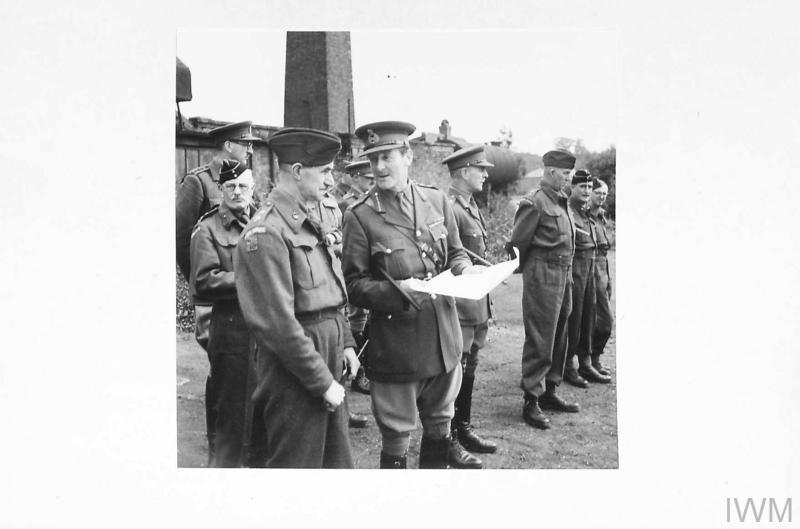
Lieutenant General T.R. Eastwood, CB.,DSO.,MC., (GOC-in-C Northern Command) witnessed a training exercise with a Home Guard colonel, Lieutenant Colonel Jones. IWM (H 21574)
The North Company headquarters was fixed as the United Services Club on Station Road, and the South Company at the Corporation bus sheds. The officers completed lists of names of volunteers, and set out with organising their companies.
Lieutenant Colonel Elwy-Jones stated at this meeting that the responsibility of the Home Guard was to guard vulnerable positions and hamper any enemy actions. The battalion history describes the moment on Monday 27 May when their planning came to fruition…. ‘in yards, school playing grounds, in front of cinemas, in the streets, could be seen a heterogenous collection of men gathering together. Tinkers, tailors, solicitors, clerks, labourers, all imbued with one idea – “Service to their Country”.
Many of these men had served with the King’s Own Yorkshire Light Infantry and other regiments in the First World War. The history describes some ‘self-consciousness’ among the men as they cast their minds back to 22 years before, and brought back their ‘soldierly habits’ from their First World War service.
Communication was a major issue for the Home Guard. Unlike the Regular Army, this volunteer force was scattered across Doncaster. They were busy working in their civilian jobs and long lengths of time could pass between parades.
The Guildhall and the cells underneath it were used as secure storage for newly delivered rifles and equipment, and scarce items of uniforms were passed between members of the LDV.
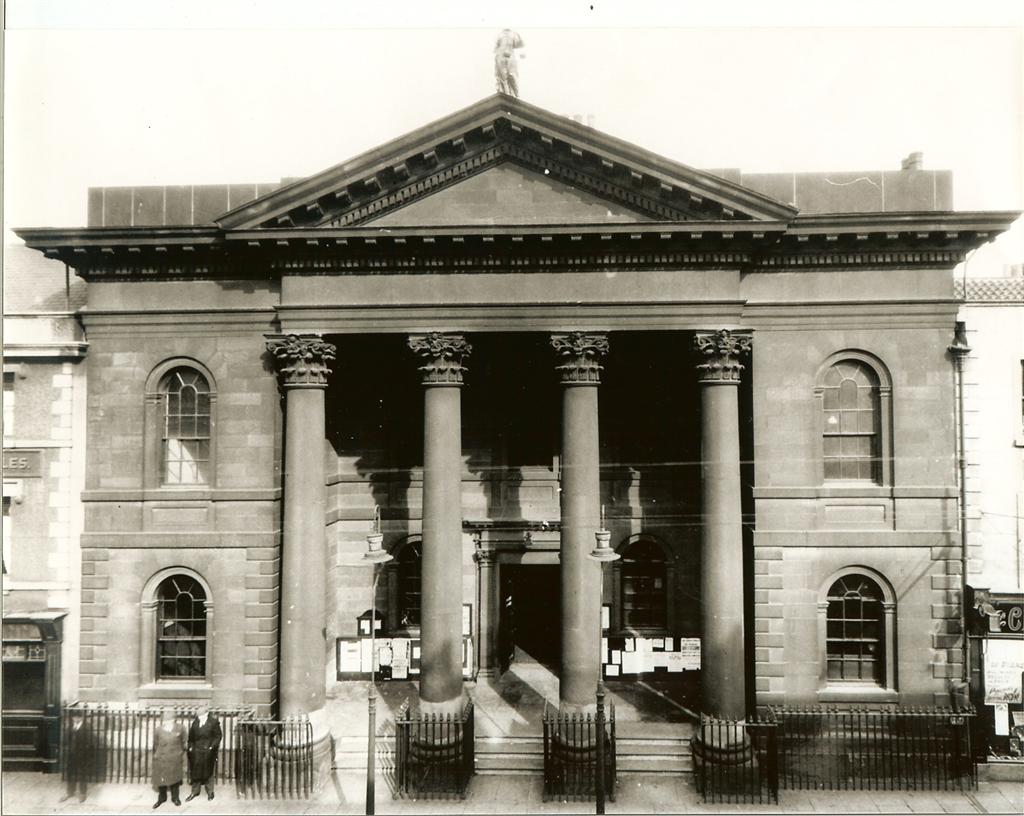
Doncaster Guildhall, City of Doncaster Archives
The history notes that by June 1940, the ‘citizen army’ started their formal guard and patrol duties, armed with rifles and shot guns. Some of the men were very rusty with weapons handling but despite this, there were no serious incidents. There were however still incidents, including ‘a shot through the floor of the “White Swan” at Balby and one in the floor of the Post Office garage’. Aside from these ‘all was quiet on the Doncaster front’.
The battalion continued to grow from June 1940 requiring reorganisation. North and South Companies were reorganised into the 5th Battalion LDV and then 3rd battalion LDV. Works units were set up within local industry including LNER, British Ropes, Curries, Tramways, Petroleum Board, Peglers, Hanleys, Electricity Department and more. Motor vehicle and cycle drivers were brought together in a specialist motor transport section.
The Doncaster Corporation, later Council, bus sheds on Leicester Avenue in Intake became an important place of activity, with the battalion’s Headquarters stationed here. Officers and storerooms were used for equipment, and the bus sheds themselves became the LDV Parade Ground. Captain F W Bridge oversaw another reorganisation, with the 5th Battalion LDV being split into lettered companies. The Company headquarters and commanding officers are listed in the history as below:
A Company – Intake School later 97 Sandringham Road – Eccleston
B Company – Transport Depot – Lord
C Company – Transport Depot – J Lister
D Company – Bessacarr Pavilion – F W Bridge
E Company – 8 Balby Road – Harrison
F Company – Ashmount Club – Chance
G Company – Hexthorpe School – Bland
H Company – Red Lion Hotel – Muir
I Company – Wheatley Working Men’s Club – Stewart
Works units were located at their work locations, supported by their employers.

British Rail Home Guard Unit, Heritage Doncaster
By 16 July 1940, the first operational orders of the Doncaster Borough Battalion LDV were issued. Barricades around Doncaster were formalised and manned and training programmes developed. As the group grew, so did the need for a more formal organisation. A new ‘Zone’ across Doncaster was formed, and Colonel William St Andrew Warde-Aldam, of Hooton Pagnell Hall, became Zone Commander. This was later replaced by a ‘Sector’ and the LDV was renamed Home Guard. From March 1941, the Battalion formally became 46th West Riding (Doncaster) Battalion Home Guard, affiliated with the King’s Own Yorkshire Light Infantry. The battalion adopted the Light Infantry Drill and wore the KOYLI chevrons.

Men of the 5th (Doncaster) Battalion of the Home Guard under attack from an ‘enemy dive-bomber’ during a training exercise at Punch’s Hotel, Bessacarr, Doncaster, 14 October 1940. The aircraft is an RAF Miles Magister trainer. Image: IWM (H 4757)
Various training exercises took place across the area, including a staged parachutist drill near Punch’s Hotel during which a mine was accidentally denotated damaging the eye of a soldier named Hetherington. Volunteers travelled to training courses across Yorkshire including bomb disposal in Leeds, Grenade training at Strensall and Tank destruction at Catterick. Training was also delivered at Headquarters in topics including battle drill, musketry, bayonet fighting, town fighting, patrols, first aid and unarmed combat. Training was formalised further with the introduction of proficiency exams in December 1941.
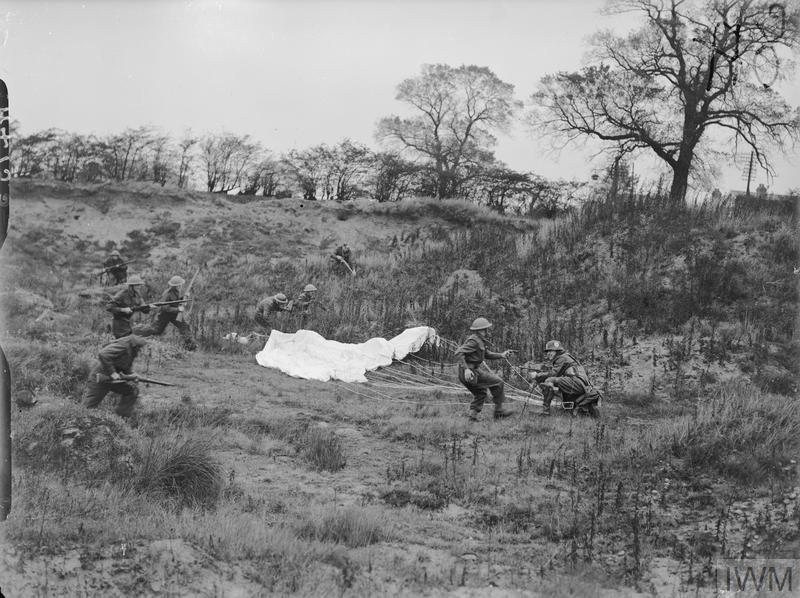
The Home Guard: Men of the 5th Battalion (Doncaster) Home Guard rounding up an ‘enemy’ parachutist during training for assisting the Army in the event of an invasion. Image: IWM (H 4755)
The local force continued to grow with the enrollment of Women Auxilliaries in 1943, undertaking work such as clerical and shorthand typing. Notably women were issued a badge, but no uniform. Local forces also supported a local Prisoner of War camp with the influx of prisoners following D-Day.
In May 1943, it was decided that the Home Guard should celebrate its 3rd birthday. The 46th Battalion held a march and Drumhead Service in Doncaster Market place. They held a demonstration at Racecourse with Battle Drill and Bayonet Fighting, rough riding by Dispatch riders, and a set piece attack on tanks loaned by the Regular Army. Donations taken at this event, and others that followed, were distributed to the Army and to Infirmary Scheme.
The charitable successes of the battalion were also notable, with the below raised at events and activities including boxing tournaments, concerts, matches, dance and auctions:
£200 for 8th Army Comforts Fund
£77 for KOYLI Regimental Funds
£36 for the Merchant Navy
£2091 for the Doncaster Infirmary
£1597 for Home Guard Company Welfare Funds
As the danger of invasion reduced, many men were transferred from the Home Guard to the Anti-Aircraft defences. From November 1944, the Home Guard forces began to wind down, and a programme of local ‘stand down’ activities took place.
On 19 November 1944 a Sector Church Parade was held at Doncaster Parish Church, addressed by the Bishop of Sheffield. The group marched past the Mansion House, the Sector Commander and Mayor was before troops proceeded to Town Fields for an event. On 3 December 1944, the final Stand Down parade of the Battalion was held on Town Fields, at which the Commanding Officer read a message from the King and thanked the battalion for their hard work and commitment. On the same day, representatives from all units of the Home Guard also paraded in London, marching past the King. Three men from the 46th represented Doncaster at this event; Second Lieutenant J Beaumont of F Company, late RSM to the battalion from inception, Lance Corporal F C Bingham of B Company who had joined at the beginning and Private C J Beaver of C Company, described by the battalion history as ‘a young enthusiastic HG’. Finally, companies held a Stand Down dinner, rounded off by a Battalion Officer’s dinner at the Mansion House. The officers were given a gold wristlet watch, to thank them for their work.
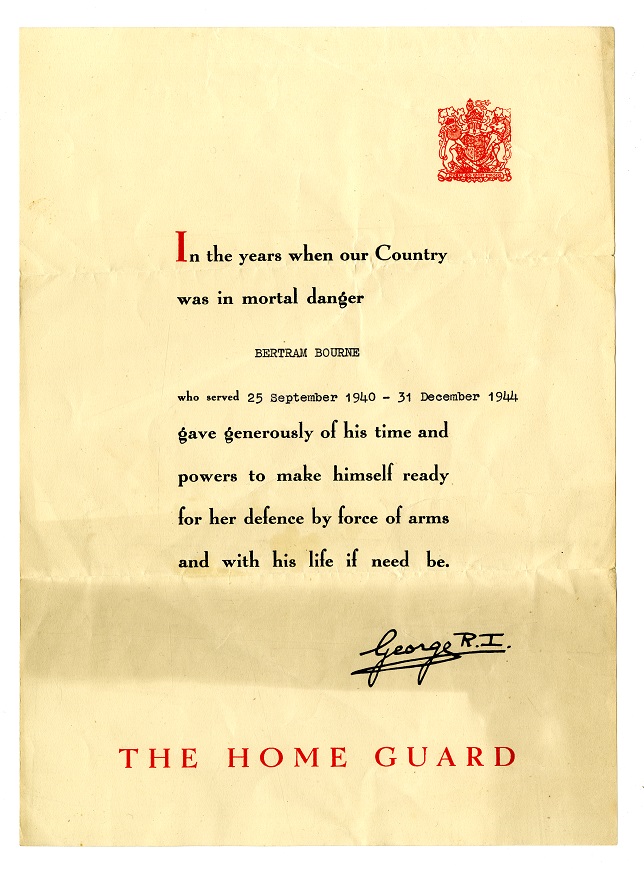
Certificate belonging to Bertram Bourne, a First World War veteran of the 7th Battalion KOYLI who served in the Wakefield Home Guard
All images of objects from the King’s Own Yorkshire Light Infantry Collection are shared under Creative Commons Attribution 4.0 International (CC BY 4.0), credit to Heritage Doncaster.