
Women and the British Army
This upcoming Saturday will be International Women’s Day. In the UK women have only been able to serve front line combat roles in the army in recent years, but this comes after centuries of women being closely tied to many different parts of army life. The history of women and the army is a large and complicated topic with many different sides to it and stories to tell. To celebrate International Women’s Day we’ve written a brief history looking at the major changes to women’s roles in the army over time.
Women have been involved in war as long as war has existed, whether as victims of the consequences of conflicts, or as parts of invading armies. For much of history armies were accompanied by long trails of supporters, wanderers, and profiteers, from soldier’s families to traders and craftsmen and beggars. When armies made camp a community of ‘camp followers’ sprang up around them. This was true for the New Model Army (formed in 1645) as well, and remained the case as it morphed into the British Army. Soldiers’ wives and children were a major contingent of the camp followers, and would carry out work across the camp to support their husbands. This included cooking for them, as well as cleaning and mending uniforms and equipment. When the army moved the women would pack up their lives and march, or ride if they were lucky enough to afford transport, behind them.

Soldiers on the march in 1811, accompanied by their wives and children (NAM. 1974-03-6-1).
Through the 1700s and into the early 1800s women’s roles became slightly more organised, and they were recognised as a regular part of army life. The wives of regular soldiers came to live under military discipline like their husbands. They were expected to carry out the domestic work expected of a wife while also being required to work for the army when the need arose. This could be assisting in military hospitals or providing schooling for regimental children, or as labourers. Some women would seek employment as servants in officer’s households as well. This work did come with some support however, as women were afforded half the rations available to a man for their efforts. According to some sources they were paid for labour as well, though we’ve not been able to find any indications that this happened consistently. There are stories of women taking up roles in battles as well, distributing water and ammunition and even defending the army’s baggage from looters.

A baggage train in 1803 on the move at the top, and with women working to unload it on the bottom (NAM. 1967-05-12-5).
The experiences of officer’s wives and daughters in these centuries was very different to the wives and daughters of enlisted men. Permission was required from a soldier’s commanding officer to marry, but from 1800 men could expect to be housed in a private room in the barracks with their wives if there was space available. Officer’s wives weren’t expected to work though, and would often live in private lodgings paid for by their husbands in nearby towns. There were many social obligations the officer’s wives were expected to meet, hosting and attending events and dinners being a major one. Maintaining a household was important too, and as mentioned above it wasn’t uncommon for the wives of enlisted soldiers to be employed as servants in these households.
When a regiment was slated for foreign deployment they’d only be afforded a small number of spaces in any transports for wives, often equal to less than 10% of the number of soldiers themselves. Officers could circumvent this if they could afford to pay for their own transport for their families, but for most couples this often meant that they wouldn’t see one another for years at a time. There were also women who would meet and begin relationships with soldiers while on foreign deployments. If they weren’t married by the time the regiment returned home, or the marriage wasn’t recognised by the army, then the women would often simply be left behind.
This complicated web of social and domestic duties and relationships, together with work as an informal labour force for the army, was a constant for the British Army into the middle of the 1800s. Driven by the need to modernise in a world that was changing rapidly, many of the duties that women had carried out, such as cooking and cleaning, became more and more run by organisations within the Army itself. Some practices, like officers paying to privately bring their wives on campaign and to house them, were clamped down on. Women’s overall presence in the day-to-day aspects of regimental life declined, but there were some exceptions. Women remained in care roles, particularly as nurses. This included well-known individuals like Mary Seacole and Florence Nightingale in the Crimean War in the 1850s.
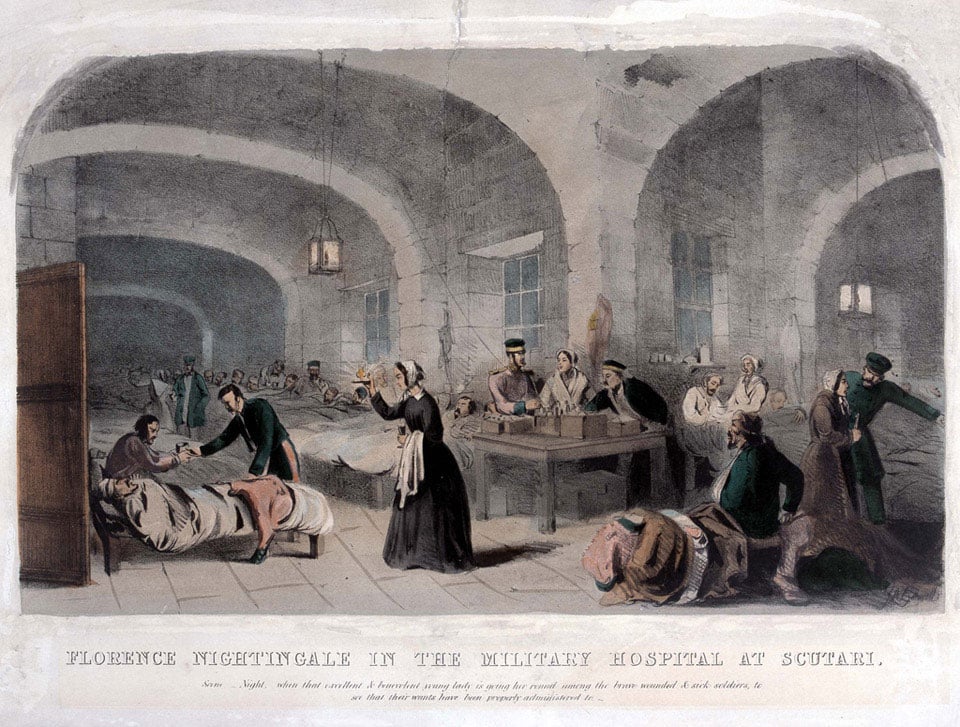
Sometimes nicknamed ‘The Lady of the Lamp’, Florence Nightingale is often seen as the founder of the modern British military nursing programme (NAM. 1978-10-57-1).
In the 1880s the Army Nursing Service was created, which trained and organised the work of nurses in military hospitals across the British Empire. The Service was reorganised over the decades, and particularly swelled in numbers during the Boer War (1880-1881). By 1902 they had become the Queen Alexandra’s Imperial Military Nursing Service, or QAIMNS. The number of nurses in the QAIMNS exploded during the First World War, from 300 in 1914 to more than 10,000 at the war’s end, serving in every theatre of the war. They continued into the Second World War and in the decades after, becoming the Queen Alexandra Royal Army Nursing Corps. They existed as an independent body within the armed forces until 2024, when they were amalgamated into the Royal Army Medical Service.
While nursing was the primary option for the majority of women interested in military service at the time, the outbreak of the First World War changed things dramatically. Warfare on such a scale was unheard of in Europe, and the numbers of men drafted into the army affected every part of British life. For women at home, this meant taking up new responsibilities, especially as the draft became more and more encompassing over the war. In 1915 a protest march was held by suffragettes in London, eager to volunteer for work supporting the war effort. By the end of the war 2 million women were working in industry across the country, which had a huge knock-on effect on the drive to give women the vote.
The war also brought women to the front lines in a new way. In 1917 a Women’s Army Auxiliary Corps was formed to free men up from certain duties in the army. Members of the WAAC served at home and abroad, but only in roles that the army deemed appropriate for women; primarily administration, cooking, cleaning, and in the stores. The Corps remained in service until 1921, when the army was being pressured to shrink down to peace-time numbers.
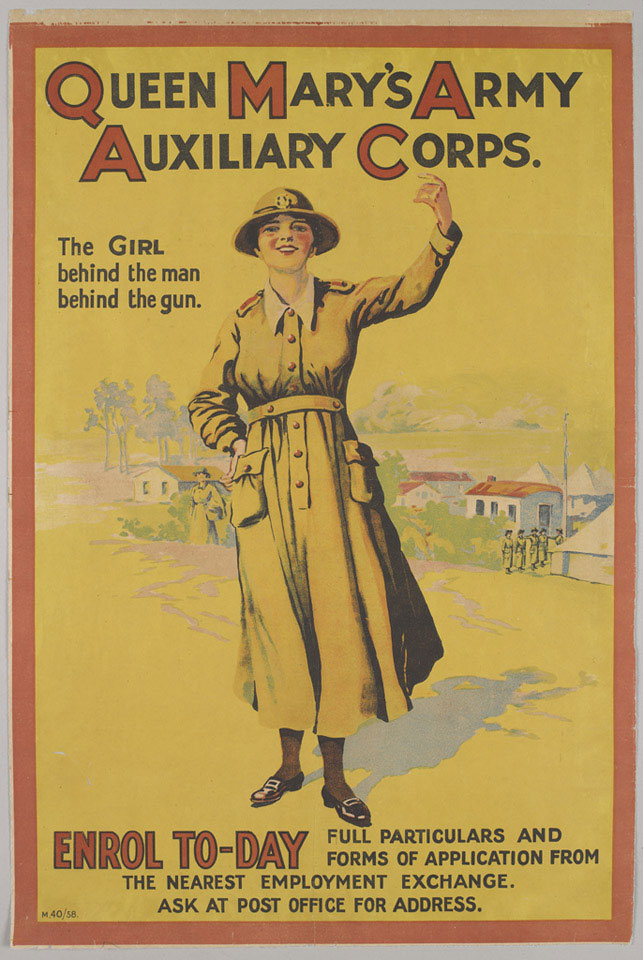
A recruitment poster for the Queen Mary’s Army Auxiliary Corps, which the Women’s Army Auxiliary Corps had been renamed to in 1918 (NAM. 1989-06-78-1).
Between the two world wars, women in the UK gained the right to vote, but representation in the army remained largely out of reach. But in the 1930s as another war looked increasingly likely, the government knew not to make the same mistakes as last time. In 1938 a new Auxiliary Territorial Service was formed. Women serving in the ATS were first considered volunteers by the army, but from 1941 they were recognised as full members of the army. The duties you could be assigned in the ATS first mirrored the WAAC from the previous war, but soon expanded to a wider range of roles, included serving with anti-aircraft batteries.

Women from all over the Empire and Commonwealth eventually joined the Auxiliary Territorial Service, such as these women from the West Indies branch, photographed around 1943 (NAM. 1994-07-283-50).
The effort, bravery, and responsibility shown by women across both wars was undeniable, and in 1949 a permanent Women’s Royal Army Corps was formed, providing professional opportunities for women seeking a career in the army. Though their duties were initially purely in support roles, this changed over time. From 1984 women were permitted to attend full officer training at the military academy at Sandhurst and progress through the same system of ranks as men. In 1992 the WRAC was disbanded and all the women serving in it were transferred into other army units.
Women still couldn’t serve in all roles, although the range available was increasing every year. In 2016 20% of roles were still considered only appropriate for men, but this changed when women were permitted to serve on the front line. The final barrier fell in 2018, when all combat roles in all branches of the armed forces formally opened to women, standing equally with men.
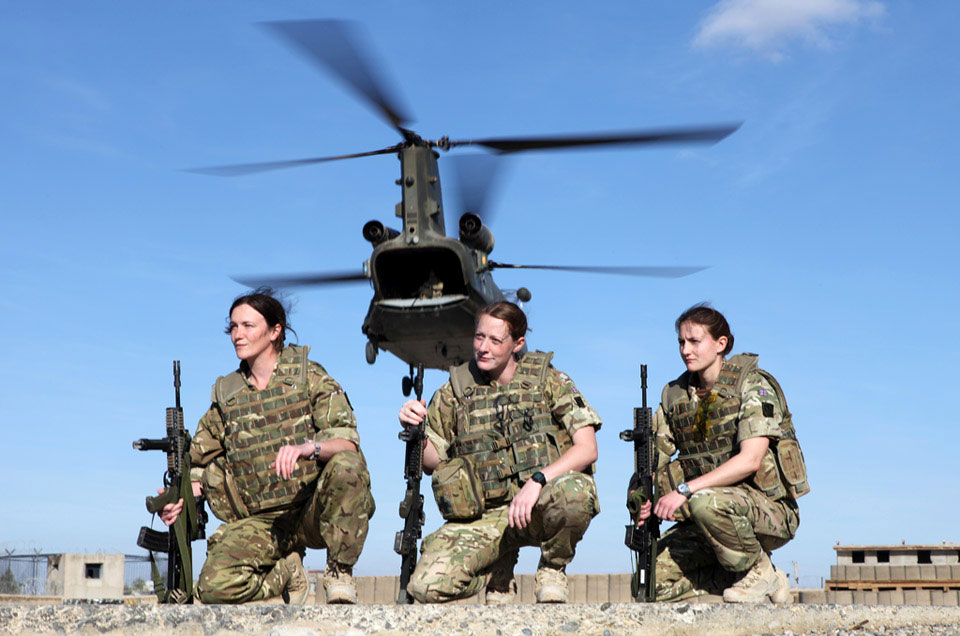
Members of The Royal Highland Fusiliers, photographed in Afghanistan in 2011 (NAM. 2015-11-55-401).
We’ve only managed to scratch the surface here, and give you a very brief look at some major roles women had in and around the army through history.
There’s one major area that we haven’t been able to touch on today, and that’s the dual responsibilities women had when raising a family while living with the army. If you are or were in a military family you’ll know how much it can affect every part of your life, and that’s why the King’s Own Yorkshire Light Infantry Museum is beginning work on a project to tell local stories about these experiences. If you’re interested in working with us on this project in late 2025/early 2026 we have a survey that you can fill in here.
Our regular Military Art Club will be running as normal on Saturday 8 March, but with an International Women’s Day-inspired twist as well, taking inspiration from the women in and around the armed forces over the centuries. All ages are welcome, as is anyone who’s served in the forces or who has an interest in military history. The session runs 10.30am – 12.30pm and is free. No booking required.