
Arthur Greenald’s Notebook
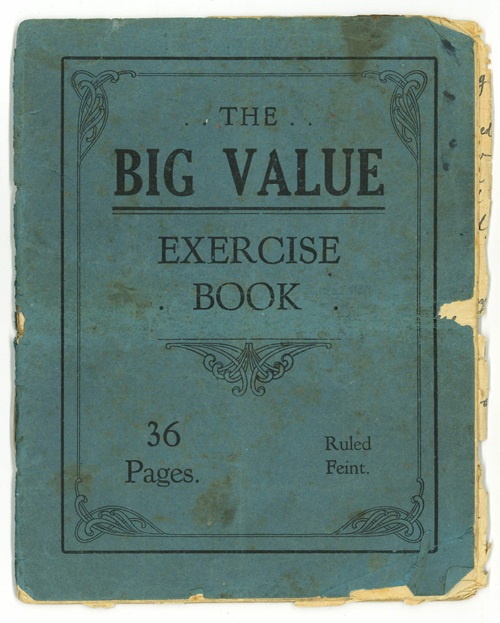
On 2 July 1917, Private Arthur Greenald of the 2nd Battalion King’s Own Yorkshire Light Infantry was wounded by aerial darts fired on a working party in the trenches. Arthur followed the casualty evacuation route through the battle lines and returned to England for treatment. During his journey and subsequent recuperation, Arthur took the time to write down an account of his experiences in an exercise book. This book was donated to the King’s Own Yorkshire Light Infantry Collection in 2025.
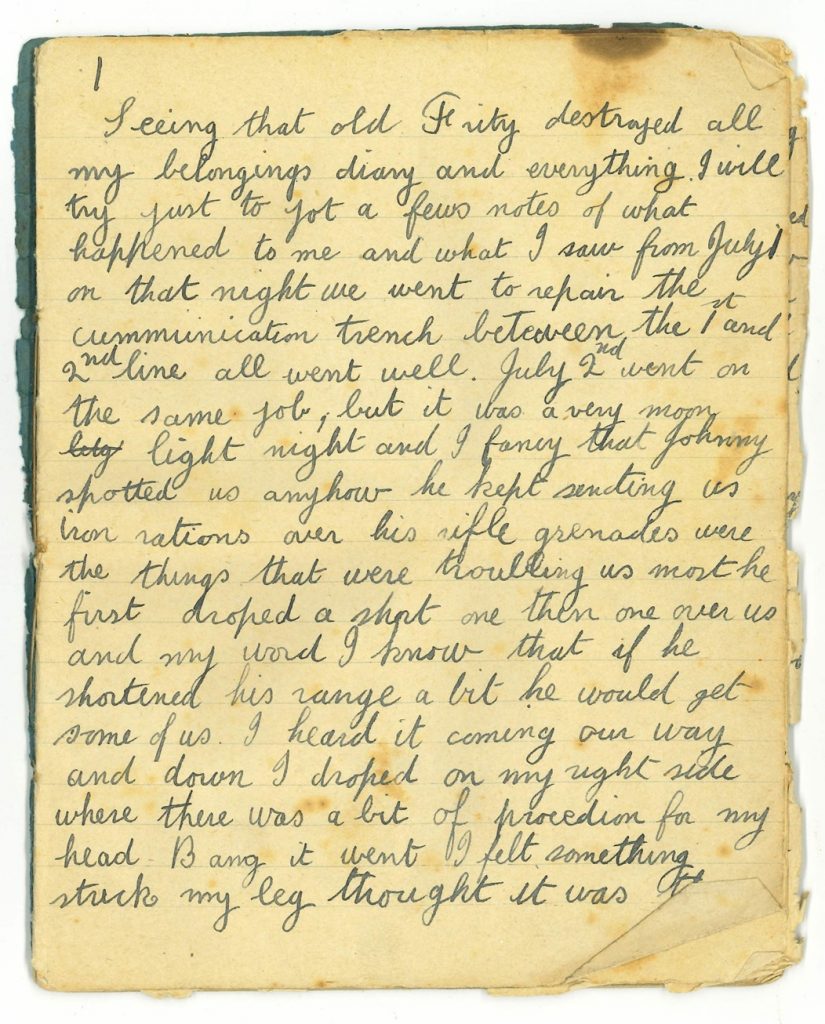
The quotes below are reproduced directly from Arthur’s writing, including some of his own spelling and grammar errors. He begins the notebook with “Seeing that old Fritz destroyed all my belongings diary and everything – I will try just to jot a few notes of what happened to me and what I saw from July”
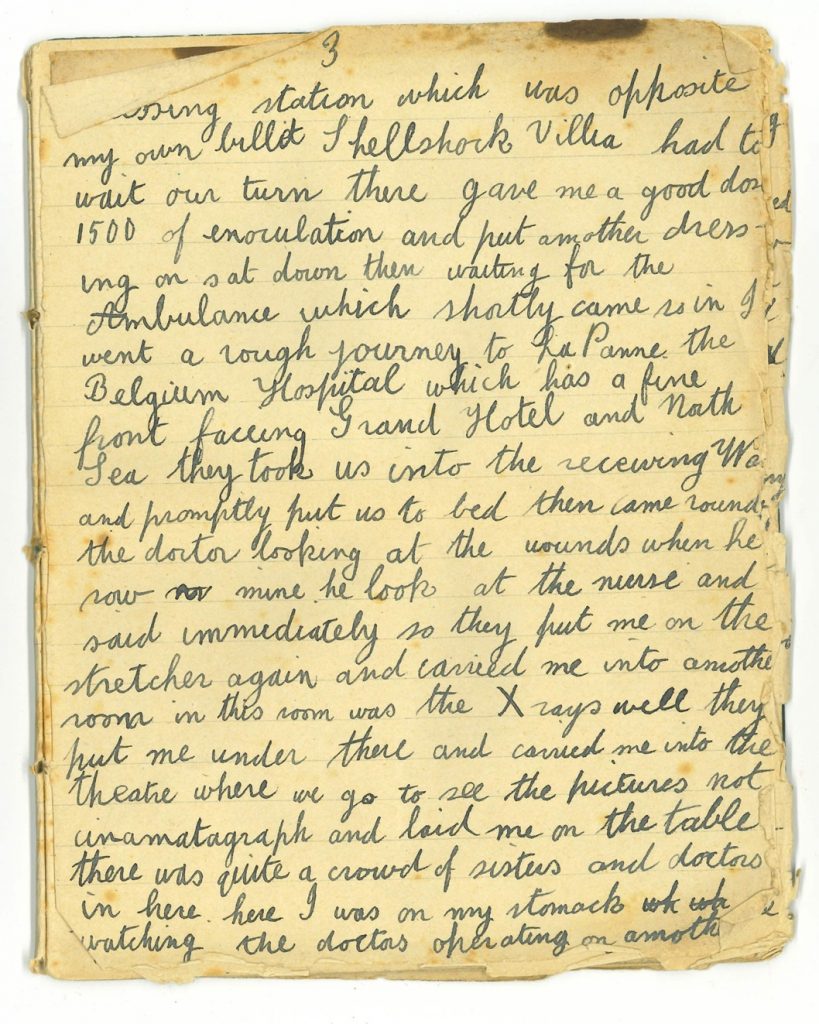
After being wounded in the leg, Arthur approached his platoon officer, a W Ward, and explained what had happened. His response “Greenald – you lucky devil you will certainly get to Blighty” was accurate. After being patched up and spending some time in ‘Shellshock Villa’, he was sent in an ambulance to a hospital, where he was immediately sent for an x-ray and treatment.
Arthur wrote “I felt them inject something into my spine which send all my body down below where they put flaid in – paralised but up about – I was as concious as I am now – in a few minutes the Broncardion Orderlion put a peice of shrapnel into my hand and said sovounnen [‘souvenir’] it was what they had cut out of my leg”.
Arthur details a specific wound cleaning treatment he received, where the doctor “put me four tubes in the wound and every 2 hours night and day they squirted some liquid down the tubes – it made it burn a bit every time – they were two sorts Carral and Lavine – the lavine is a yellow fluid – the sister says it is an English discovery since the war broke out but it is an excellent thing for healing the wound…” This was eventually reduced down to just one type of fluid.
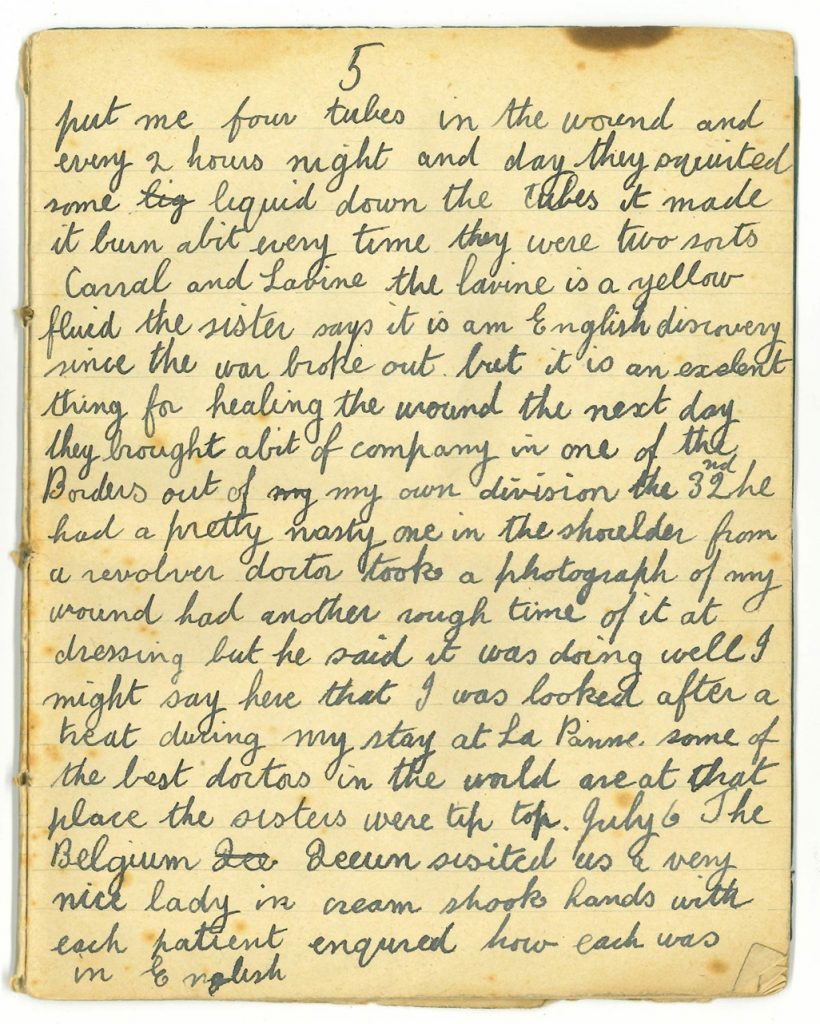
The account also details a visit of the Belgian Queen, who Arthur describes as “a very nice lady in cream”, who met each of the patients and gave them a gift of cigarettes and chocolate. Arthur also makes a point of noting down that the patients received “a decent issue of beer every day”.
Arthur was later moved in a Motor Ambulance and then an Ambulance Train to another treatment location, the 32nd Australian Stationary Hospital. It is clear the doctor saw the severity of Arthur’s wound, although Arthur admits he didn’t really understand the process but just wanted to get back to England. He wrote
“as soon as he saw it he took my card and marked me for Blighty a B case – I don’t know what that means by anyhow I got what I wanted so I did not care what it meant – stayed there till Thursday then told to put pyjamas and get ready to sail – you bet that was not a long job – another shake up by motor and a wait on the docks then a board the Hospital ship St Dennis a beautifull fitted up boat”
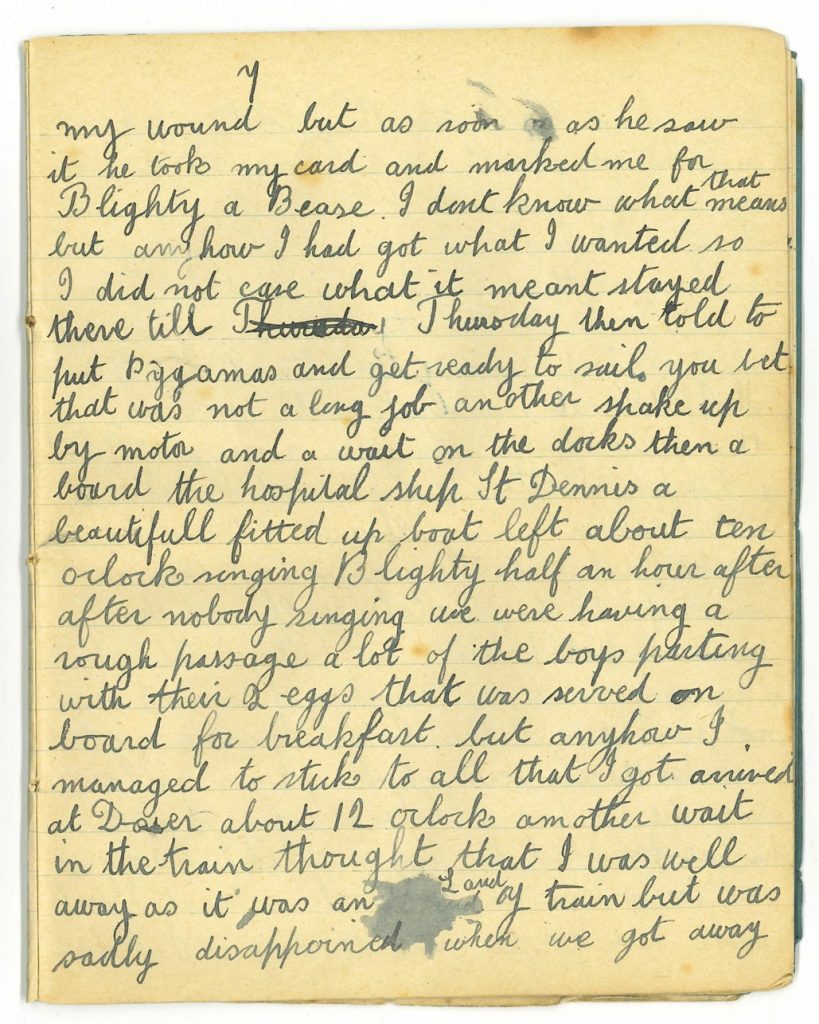
The wounded soldiers started out the journey singing but the rough journey put a stop to that within half an hour. Arthur arrived back in the England and was put onto another train, and sent to Bevan Hospital at Sandgate. Of this hospital Arthur wrote “looks very nice room only 4 beds – a London Scottish a Sherwood Forester a Australian and myself quite a decent party – this hospital faces the sea – in fact the sea comes up to the Hotel wall and the patients sit out on the balconies – it is very nice so they say of course I have not seen it yet – the air is very sweet – my bed is under the windows which open night and day.”
Arthur’s preference was to be sent to Blackpool, a point he made clear in a conversation with a nurse. “I had a bit of a conversation with the sister and she told me that whenever possible they send the boys as near home as possible when they get convalescent but they have sent some of the North County lads to Blackpool – let us hope that they send me there – the weather is beautiful – would like to get out but the sister says I must stay where I am for a few days”
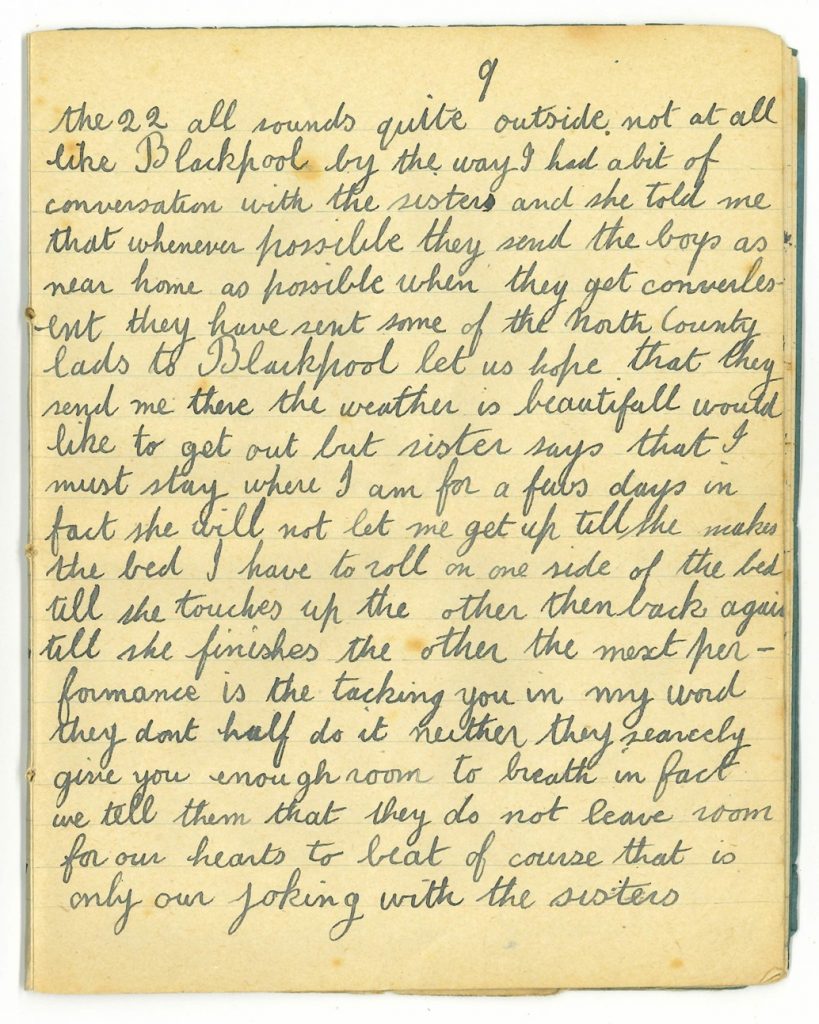
The attention to detail provided by the nurses is also a point of note for Arthur. He writes of a nursing sister who treats him “she will not let me get up till she makes the bed – I have to roll on one side of the bed till she touches up the other then back again till she finishes the other – the next performance is the tucking you in – my word they don’t half do it neither – they scarcely give you enough room to breath – in fact we tell them that they do not leave room for our hearts to beat – of course that is only our joking with the sisters…”
Later he dares to ask the sister if he can sit up while she changes the bed. This didn’t pan out for him… “she says no and she is the master of the situation and I must do as I am told and ask no questions…”
At this point, Arthur’s notes become a little more serious and contemplative. He writes “it is hard to think that only a few miles away men are stood in trenches – human targets is that all you can call them – hoping I and some praying for a Blighty so that they may get out of it for a while and see there dear ones at home”. However he then follows this up with a reflection on the tone of this part, writing “I am getting a bit serious and I did not intend to do that when I started these notes – am doing it to pass a bit of time away as one gets tired when you have nothing to do but smoke cigs and study over anything that comes in your mined”
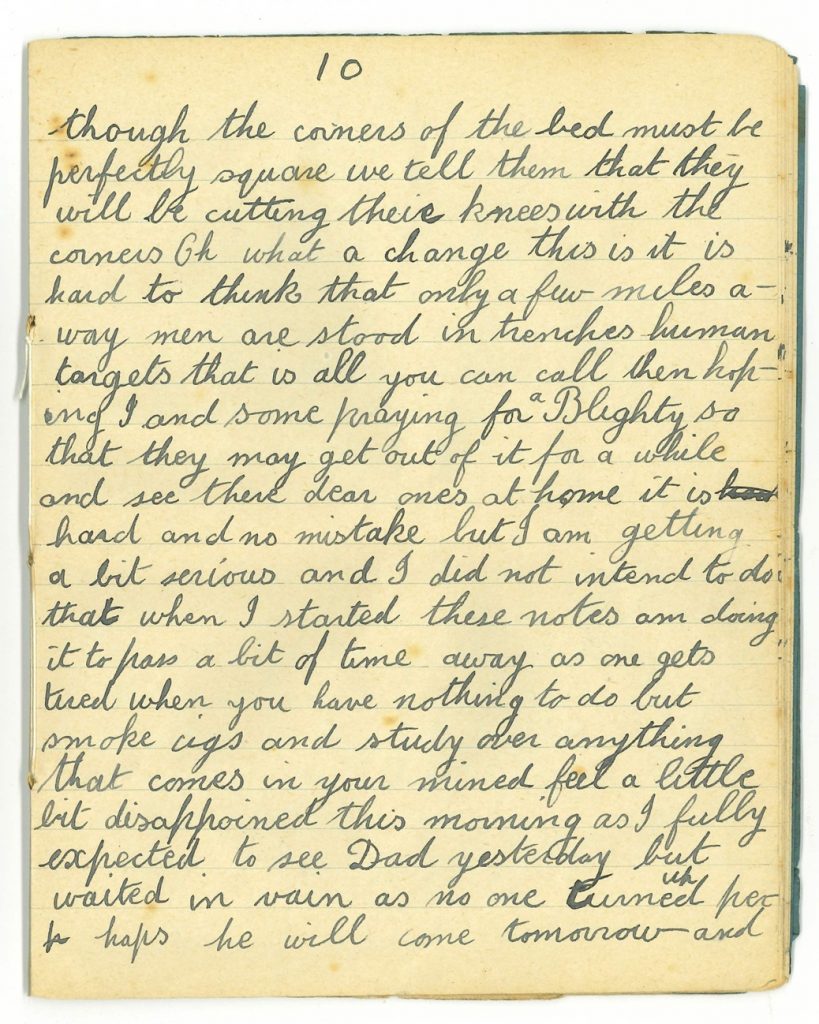
Arthur patiently awaited a visit from his parents, who he notes he hasn’t seen for 10 months. He also notes how his world has expanded since serving, remarking that he has travelled more than ever before.
The subject of the harrowing battles is also covered in Arthur’s reminiscence, where he describes the battle of Beaumont Hamel as his “baptism”. He writes that this was the worst engagement he was involved in. He touches on the hopelessness he felt and the psychological impact of the fighting. He wrote “I found a decent shell hole – but my word – was not I in a state when we scrambled out of the sunken road – talk about been half dead – I just felt that I did not care a pin whether Fritz put my lights or not – it is an awfull feeling but it goes off in time”.
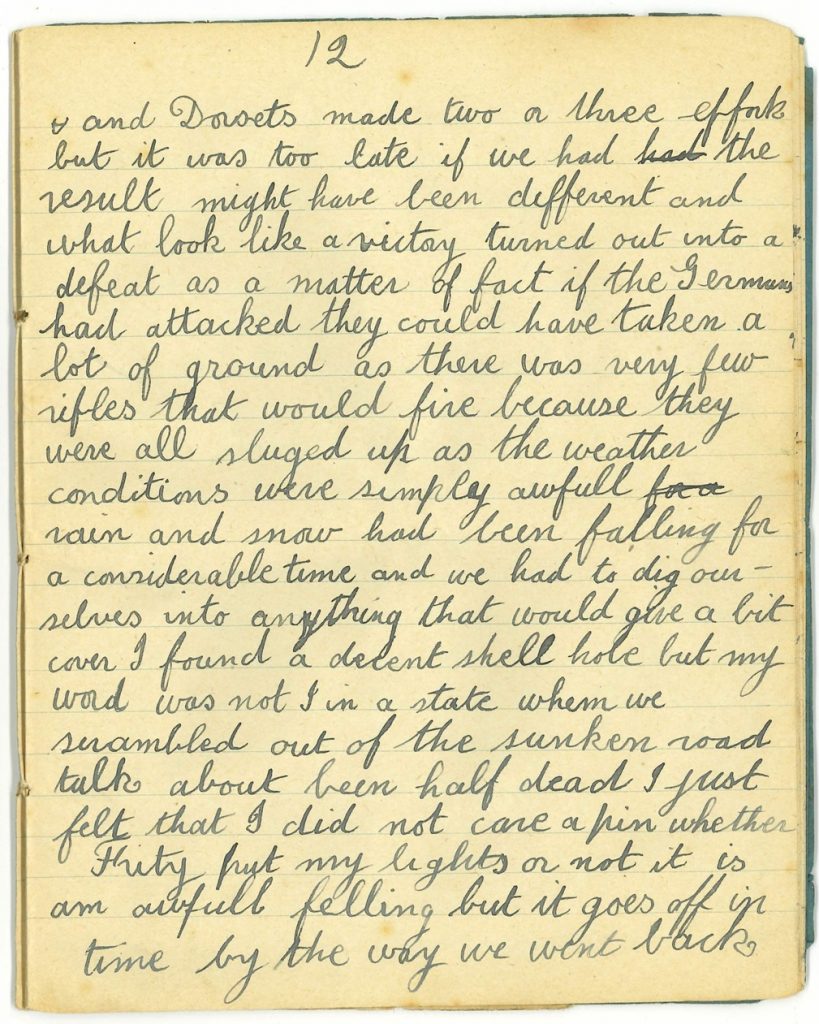
Arthur also wrote about the experience of taking German prisoners at the same action that John William Ormsby won his VC. He writes that the German’s “seemed to be pleased to be taken prisoners and were shaking hands with each other – a lot of these were only bits of lads that had been called up about 7 weeks…”
At this point Arthur’s diary ends. It may have been that he was moved again for further treatment and found something else to occupy his mind. He does appear to have made it to Blackpool, as this photograph of him in his hospital blues was taken by a Blackpool photographer.
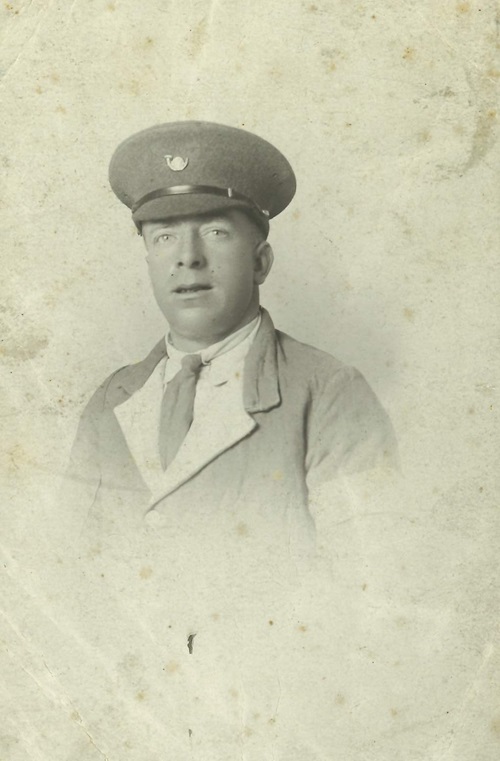
Arthur survived the war, and returned home to Dewsbury. He worked in the textile industry and married Charlotte Graham. He died in 1944 in Dewsbury aged 61.
All images of objects from the King’s Own Yorkshire Light Infantry Collection are shared under Creative Commons Attribution 4.0 International (CC BY 4.0), credit to Heritage Doncaster.