
Dogs in the Army
Dogs have been companions to humans for thousands of years. In the army they’ve been regimental mascots and the companions of men a long way from home, but they’ve also carried out important work to protect soldiers from injury or attack. Last summer the King’s Own Yorkshire Light Infantry Museum worked with young people from across Doncaster to produce a series of podcasts called The History Report. One of these was about dogs in war, including dogs in the King’s Own Yorkshire Light Infantry (KOYLI). You can watch or listen to the podcast below, but to go along with it we’ve written this blog giving you some historic context and examples of dogs from across the army’s history.
Regiments taking animals as mascots goes back a long way. Sometimes they’re officially recognised and sometimes they are unofficial. The official mascots are officially looked after by the Royal Army Veterinary Corps, and normally have a service number and a rank like any human soldier. Meanwhile the unofficial mascots are fed and housed by the individual regiments, who front any costs involved. The KOYLI have had multiple mascots over time. They weren’t always dogs; there was a mule called ‘Paddy Boy’ in the 1890s, but during the First World War, men from the 8th Battalion KOYLI took in a dog called Peter. Unfortunately we don’t know very much about Peter, but here he is photographed with some men and officers from the battalion, in France.
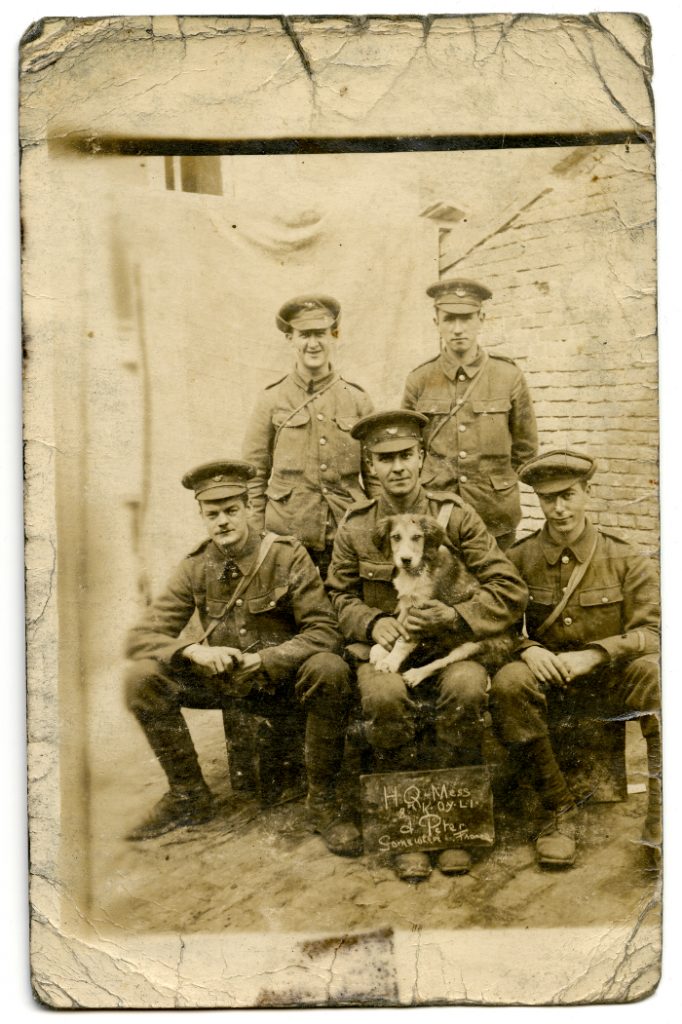
Peter with officers of the 8th Battalion in Franc. By kind permission of Jane Harrison.
Dogs have working roles as well, that take advantage of their speed, agility, intelligence, and developed senses. Dogs were sometimes used in the First World War, to carry messages or urgent supplies, or to find surviving comrades or hiding enemy soldiers. The dog in the photograph above (which is from about 1916) is leaping over a French soldier to deliver a message across No Man’s Land. The keen sense of smell that dogs have is also incredibly useful in search teams, and they’re often used in bomb disposal, helping identify and point out hidden explosives that their handlers might not have seen.
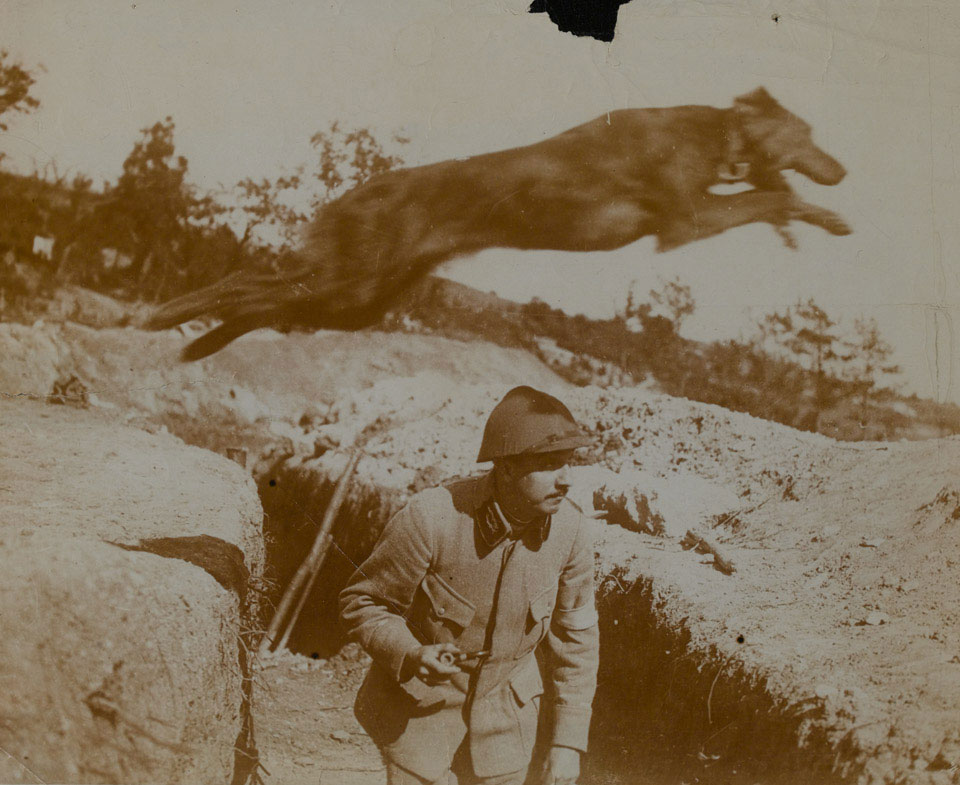
A messenger dog from the First World War (NAM 2002-02-589-103).
Sometimes dogs end up being taken in by soldiers or people working around armies and regiments, such as Vic, a terrier taken in by Albert Drury from Wheatley, Doncaster. Albert served with the Green Howards, joining them in summer 1914. While serving in northern France near Armentieres, his battalion were stationed in a school building in an evacuated settlement. There were many stray dogs around that had been abandoned, and one, a small black and tan terrier, attached itself to Albert, sleeping on his feet at night. When due to return home for leave, all the men were ordered to shoot the dogs, which couldn’t return with them to the UK. Albert hid Vic first in his kitbag and then in the chest pocket of his greatcoat. When the men lined up for inspection before embarking on their ship, Vic stuck his head out of the pocket as the inspector walked past. Without changing his expression at all, the inspector said “If anyone sees this, I haven’t seen this”. Albert Asked his mother and sister to meet him at Doncaster station with a collar and lead. When his train pulled into the platform, Albert leaned out the window to pass Vic down. He had the collar and lead fitted and greeted Albert exiting the train as if he were the family dog. Vic went on to live 16 more years after this, and was always called ‘Vic from Armentieres’.
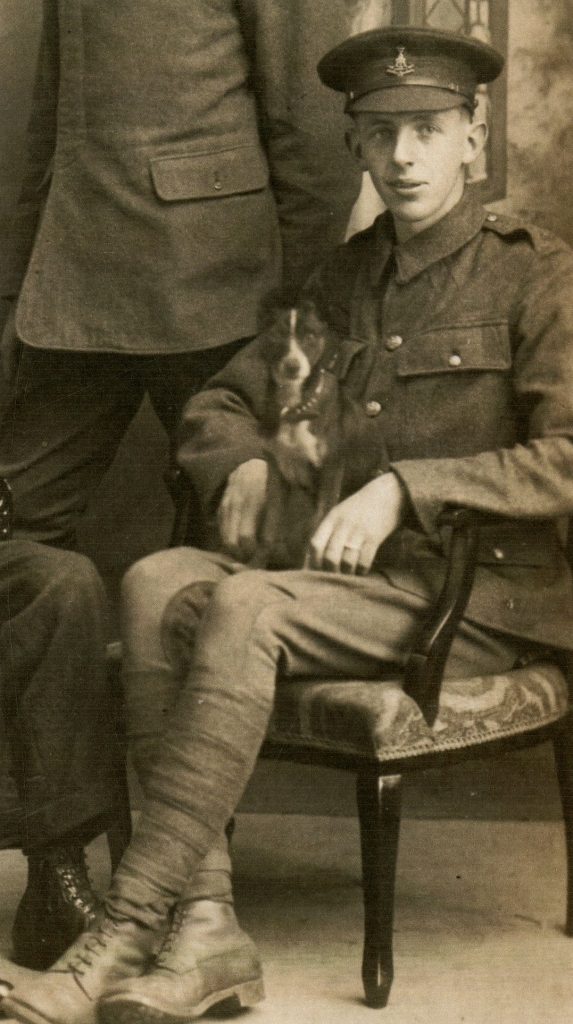
Albert Drury with Vick on his lap. By by kind permission of Isobel Sampson.
Another example that we like comes from about 1750, and is held by the National Army Museum in London. It’s a lithographic print depicted a woman called ‘Belgrade’ and a dog called ‘Clumsey’. Belgrade was the nickname of a woman who served as a cantiniere, providing water for soldiers, during a campaign in Hungary. She was always accompanied by Clumsey and the two braved danger during battle, providing water and helping the wounded. The text at the bottom of the print describes a moment before the Battle of Dettingen in 1743 when the British army was lined up ready to fight a French army. A French dog ran out from among their lines, only for Clumsey to charge out and chase him back into the French formation, before coming back quietly to the British lines. We don’t know what ultimately happened to Belgrade or to Clumsey, but we sincerely hope both lived long and happy lives.
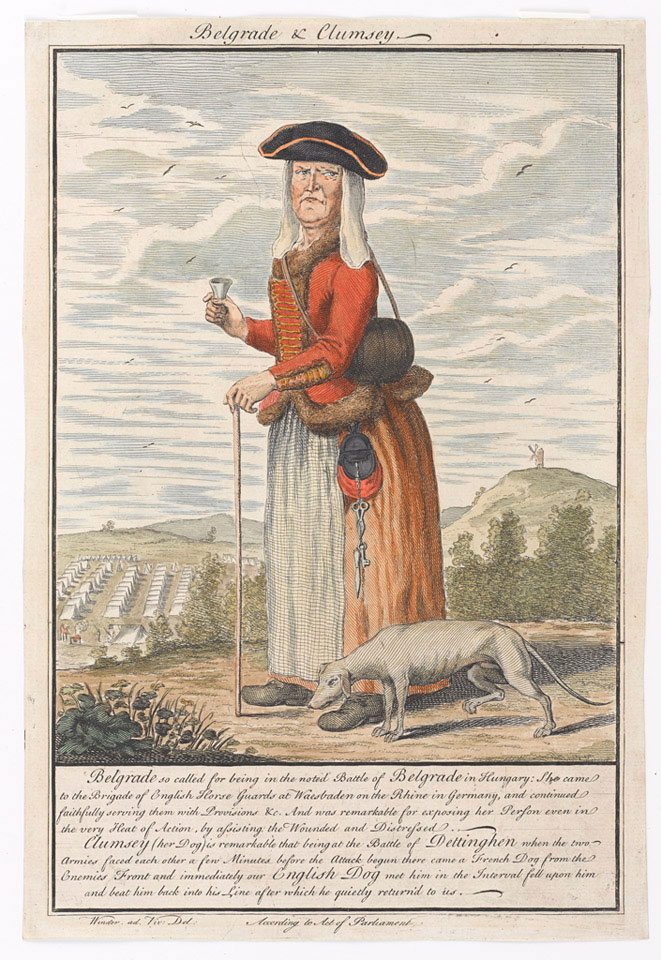
Belgrade and her dog ‘Clumsey’, produced in about 1750 (NAM 2007-01-20-1).
Dogs will most likely continue to be involved with the British Army as long as it exists. Did you or anyone you know have one in the forces? Or perhaps you had a regimental mascot? We’d love to hear from you if so! Email us on [email protected]
All images of objects from the King’s Own Yorkshire Light Infantry Collection are shared under Creative Commons Attribution 4.0 International (CC BY 4.0), credit to Heritage Doncaster.