
The 51st at Waterloo
The Battle of Waterloo was part of what is often called the Hundred Days Campaign. Allied forces manoeuvred through France and the Netherlands attempting to prevent Napoleon from securing his position as emperor of France. The King’s Own Yorkshire Light Infantry did not exist in the Napoleonic Wars, but one of its predecessors, the 51st Regiment Light Infantry, took to the field at Waterloo.
We’re lucky to have some remarkably detailed sources from this time, written by members of the 51st and surviving to this day. Life of a Regimental Officer was written by Samuel Rice, who had served in the regiment since 1793. By 1815 he was the lieutenant colonel and commanded the 51st at Waterloo. The letters of Serjeant William Wheeler give us a perspective of a man closer to the regular soldiers than his commanding officer was, and the account of Frederick Mainwaring, then a lieutenant, shows us the point of view of a junior infantry officer in the Duke of Wellington’s army.
By 1815 the 51st was 60 years old, having been raised as the 53rd Regiment of Foot in 1755, before it was renumbered. It served throughout the Napoleonic Wars, arriving in Portugal in 1811 under the command of Hugh Henry Mitchell who featured in our previous blog about letters in our collection. The 51st fought through Portugal into Spain and joined in the invasion of southern France in 1814, when Napoleon surrendered and was exiled.
The 51st left France after the surrender but returned when Napoleon escaped his exile in Elba and travelled to Paris, gathering an army as he went. Within two months the 51st were in the town of Grammont near Brussels, awaiting orders. By 16 June a British, Dutch and allied German army had assembled at the village of Quatres Bras under the command of the Duke of Wellington, with another Prussian army marching to meet them. Napoleon intercepted the Prussians at Ligny while another French force held Wellington’s army in place. The Prussians retreated and Napoleon turned his forces towards the Anglo-Dutch-German force, which camped at Waterloo, on the road south of Brussels.
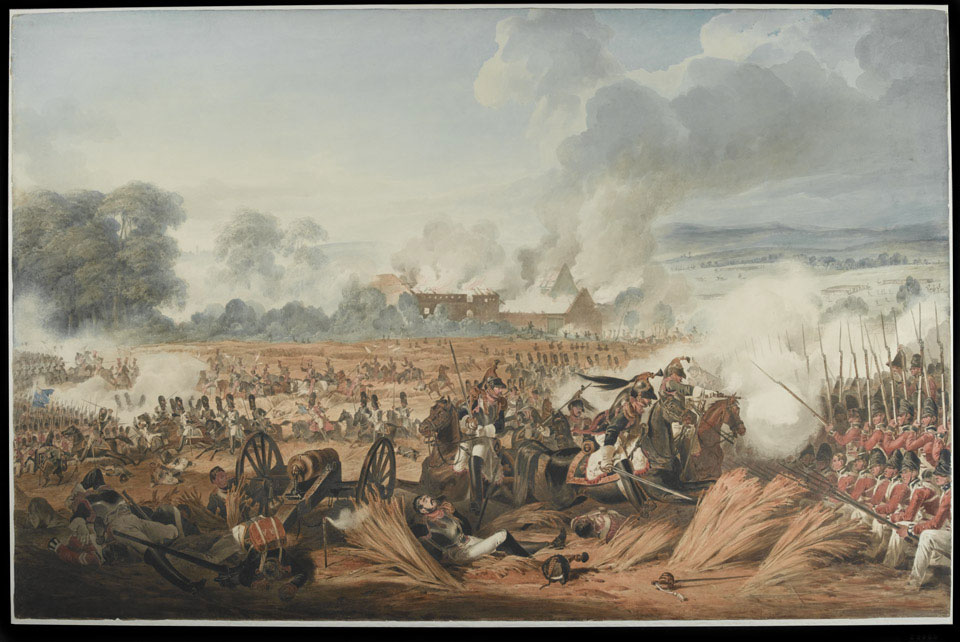
At the time the 51st was made up 53 officers and 742 other ranks. Of the non-officers, 575 were English, 8 Scottish and 158 Irish. One man was listed only as ‘foreign’. Lieutenant Colonel Mitchell was given command of the 4th Brigade which included the 51st in April, passing command of the 51st temporarily to Lieutenant Colonel Samuel Rice.
The 51st spent the night camped in a field of rye near the chateau of Hougoumont, trying to find some comfort despite the heavy rain. So as not to reveal their positions, the officers had forbidden the lighting of fires, and by morning many men were completely soaked. In the morning they were ordered to take positions on the extreme right of the army’s lines, to protect them from any French attacks to their flank. The companies of the 51st spread into a loose formation in front of the main line to protect the front of the rest of the regiment, further back and in the main Allied line.
Among the light infantry was both Lieutenant Mainwaring and Serjeant Wheeler. The battle began at 11am with an attack on Hougoumont, and the 51st were forced to repel multiple probing attacks. Early on Serjeant Wheeler was shot in the knee but refused to leave his position. This first attack saw the light men of the 51st open fire and, according to the men present, they heard no more British gunfire for the next 20 minutes. This would make the 51st Regiment the first British regiment to fire at the French in the battle, which would remain a source of great pride for the rest of the regiment’s existence.
Early in the afternoon a group of French heavy cavalry, known as cuirassiers, accidentally found themselves surrounded. They surrendered and then subsequently escaped before running into a company of the 51st under Captain John Ross. The 51st opened fire and the cuirassiers surrendered for a second time. The number of cuirassiers killed was, according to Ross, only 8, but number would inflate to as many as 80 over the years as the tale grew grander in each retelling!
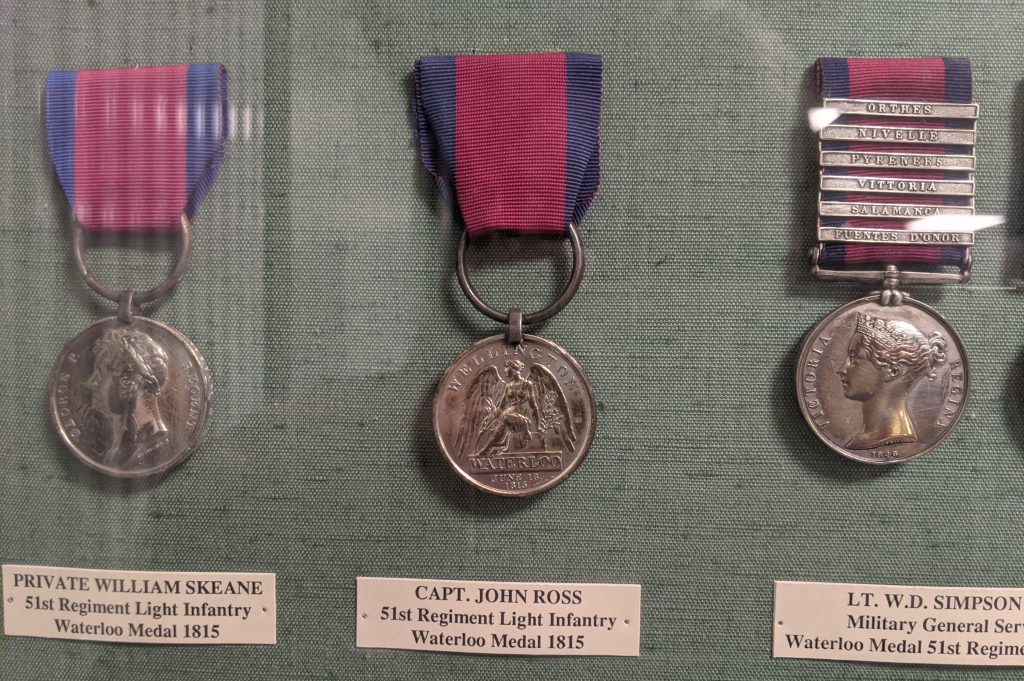
By 6pm the 51st and the rest of the 4th Brigade had been under heavy artillery fire, but the majority of the 51st hadn’t seen direct fighting. Lieutenant Mainwaring saw in the distance the last major French attack in the battle, where the French Imperial Guard regiments were advancing uphill towards the British line, half a mile from the 4th Brigade’s position. When they were only 40 yards from the British, the men lying down amongst the dead to protect themselves from artillery fire stood up and delivered rapid fire into the French, who retreated in confusion. During the chaos French cavalry attempted to salvage the situation, but were repulsed with heavy casualties on both sides. Meanwhile Prussian reinforcements were arriving and attacking the French flank, and Napoleon’s army collapsed.
The total number of casualties is unclear. Some records state the 51st only suffered 5 casualties: Privates Turner and Seaton, Corporals Pounds and Winslett, and Bugler Quin, though some accounts increase this number to 9 without providing names.
The men were ordered to camp on the battlefield itself. Serjeant Wheeler seems to have acquired a piece of beef, which he cooked on the steel breastplate of a French cuirassier. Mainwaring slept on the ground in Hougoumont’s orchard.
Research is ongoing into the stories of the men of the 51st who fought at Waterloo.
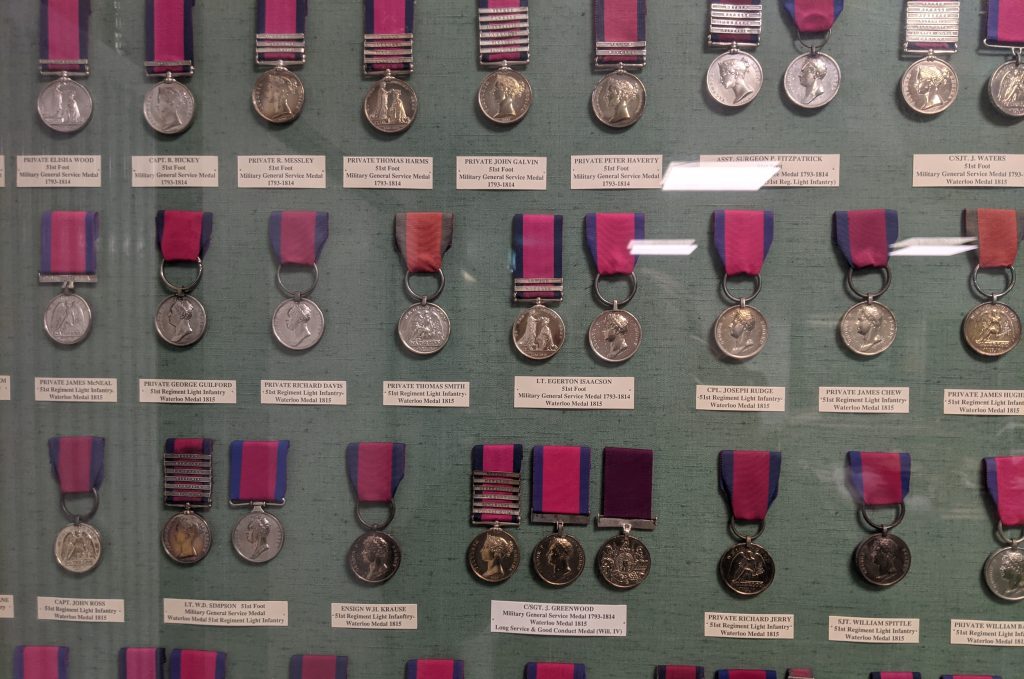
All images of objects from the King’s Own Yorkshire Light Infantry Collection are shared under Creative Commons Attribution 4.0 International (CC BY 4.0), credit to Heritage Doncaster.